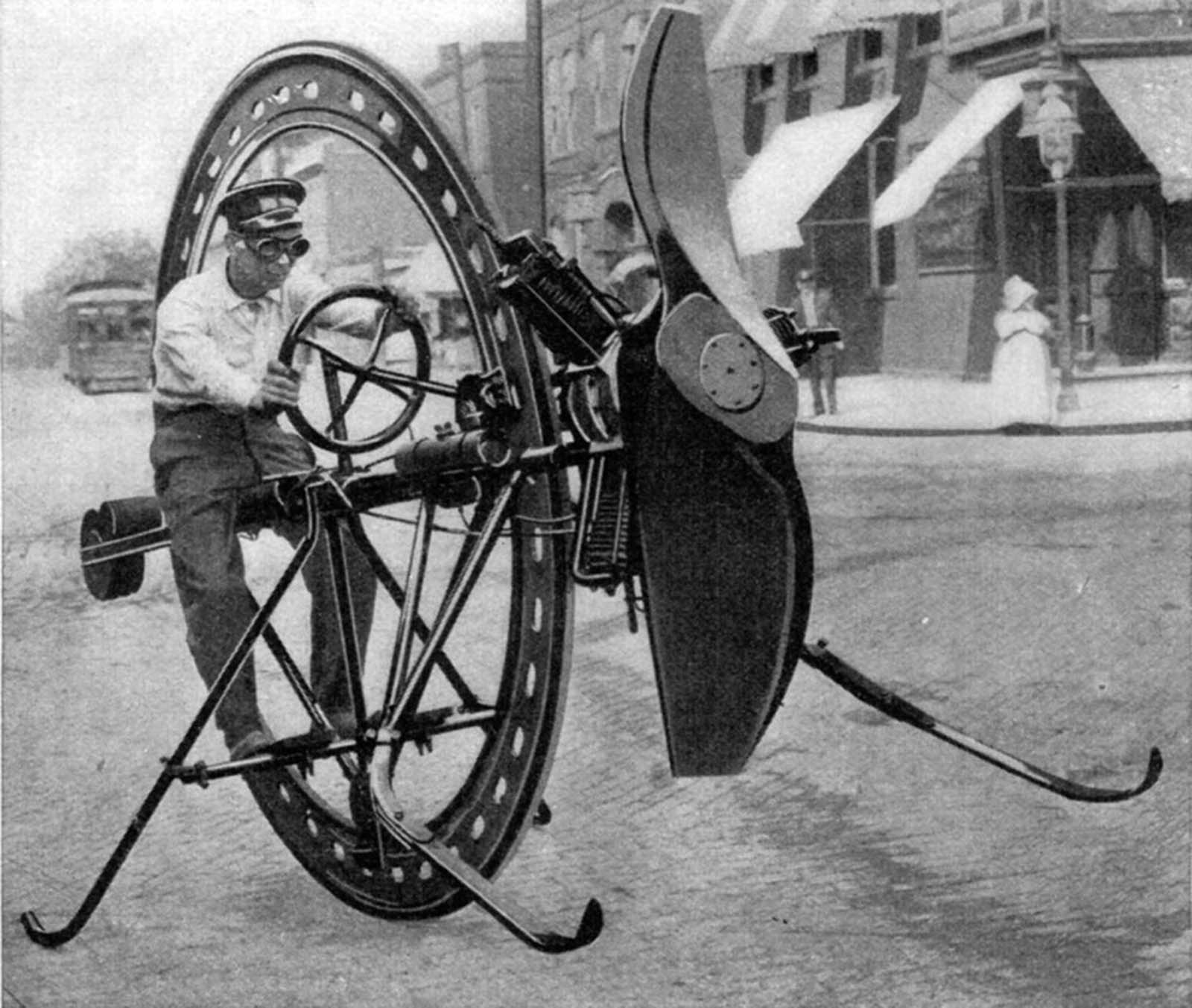
Alfred D’Harling’s “Aero-unicycle” looks like something rolled out of a workshop where bicycle mechanics and aviation tinkerers traded ideas over oily rags and big dreams. A single oversized wheel dominates the frame, perforated like an industrial rim, while a seated operator grips a steering wheel as if piloting a tiny craft. Out front, a large propeller and engine assembly take center stage, giving this one-wheeled machine the unmistakable attitude of an experiment meant to move by air and audacity rather than pedals alone.
On the street around it, everyday life continues—storefronts, awnings, and distant onlookers—making the contraption’s odd geometry feel even more striking against a familiar urban backdrop. The chassis is a lattice of metal struts, with skids or outriggers extending to either side like training wheels reinvented for a daredevil era. Details such as goggles and a peaked cap add to the sense that this invention belonged to a moment when personal transport was still a frontier and “safety” often arrived after the first public demonstration.
For anyone fascinated by early 20th-century inventions, experimental vehicles, and the lineage of unusual personal aircraft concepts, this historical photo is a vivid reminder that progress is rarely a straight line. The aero-unicycle sits somewhere between motorcycle, monowheel, and propeller-driven dream—part engineering problem, part showpiece, and entirely unforgettable. Whether it ever proved practical matters less than what it represents: an age when inventors pushed mobility forward by trying the improbable in full view of the street.