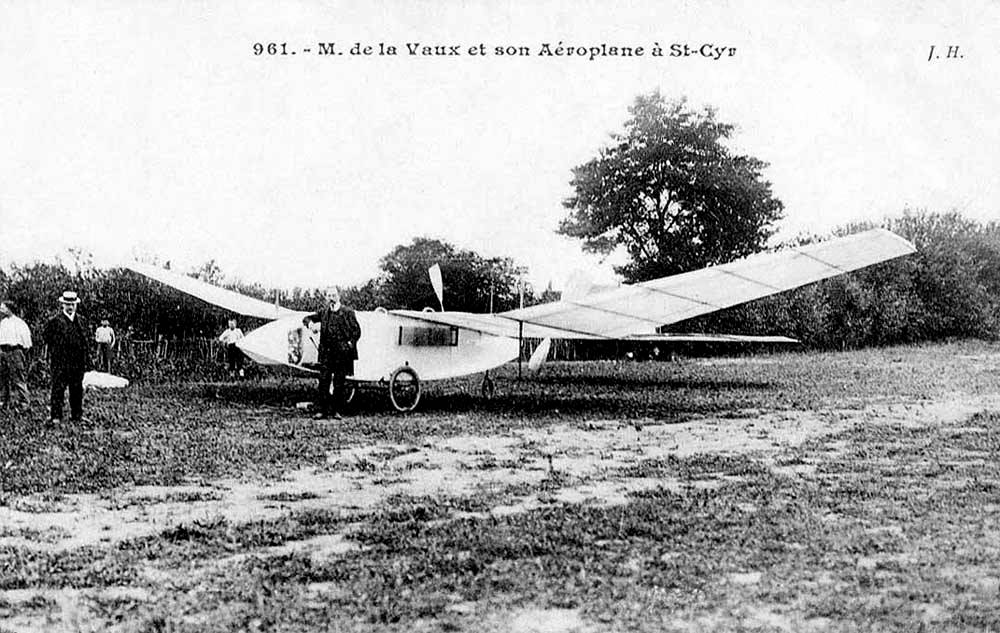
Across a rough grass field, an early aeroplane stretches its broad wings like a patient experiment waiting for the next trial. The caption identifies “M. de la Vaux” with his aircraft at St-Cyr, anchoring the scene in the formative years of aviation when flight was still closely tied to hands-on invention. A few figures in hats and dark coats stand nearby, spectators and assistants sharing the same cautious excitement that surrounded every machine built to leave the ground.
De La Vaux’s craft appears built for practicality as much as daring: a compact fuselage, simple landing gear, and wide, lightly framed wings that speak to the era’s trial-and-error engineering. Nothing here feels mass-produced; the aeroplane looks assembled from ideas, materials, and persistence, the kind of workshop-born innovation that defined early aviation history. Even at rest, the machine suggests motion—an object designed to turn open countryside into a runway.
For readers interested in inventions and the human stories behind them, this historical photo offers a vivid glimpse of pioneering aeroplane design before airfields became modern infrastructures. The setting at St-Cyr, the modest crowd, and the aircraft’s stripped-down elegance all point to a time when progress depended on small teams, public demonstrations, and the willingness to risk failure in pursuit of lift. “De La Vaux” becomes more than a title here; it serves as a doorway into the inventive spirit that helped shape the first chapters of flight.