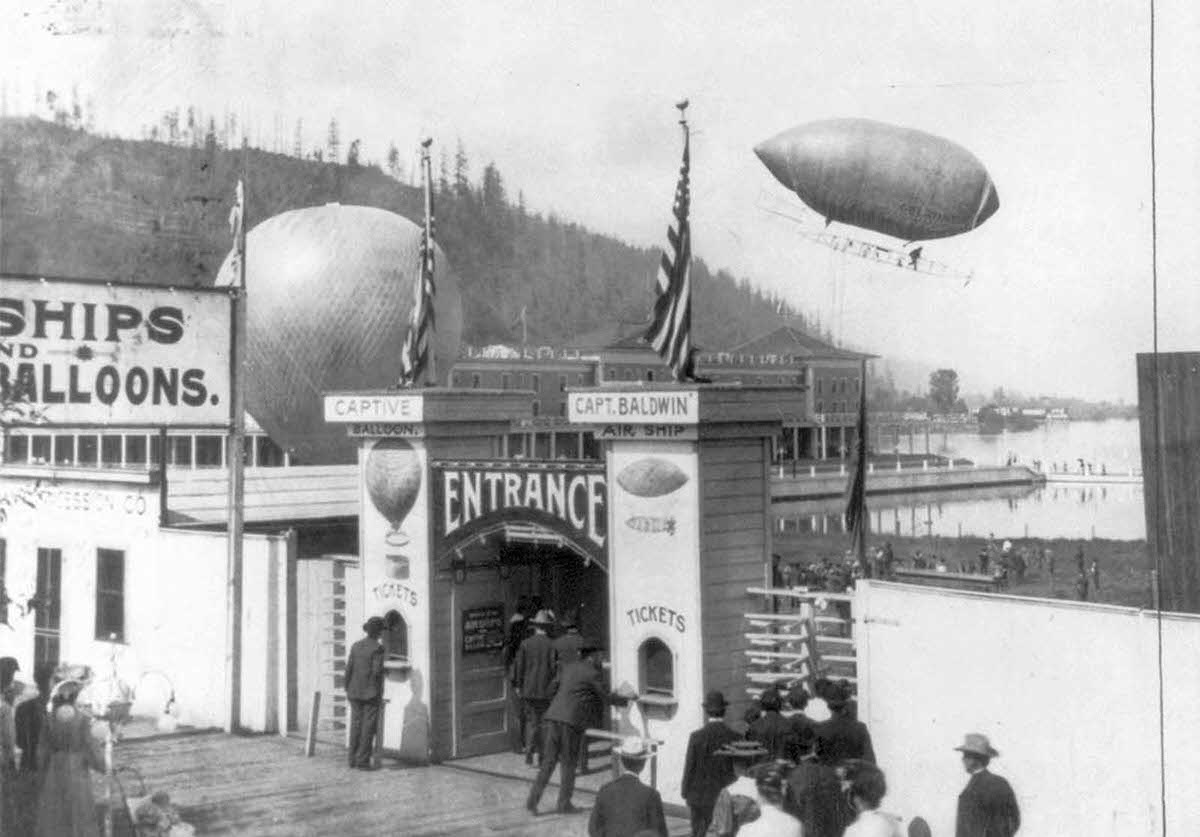
Crowds cluster at a fairground gateway marked “ENTRANCE,” while ticket windows and bold signage promise “Airships and Balloons” alongside a “Captive Balloon” attraction. Overhead, an elongated airship drifts back into view, its streamlined envelope and small suspended framework hinting at the engineering leap that made controlled flight more than a dream. The scene’s flags, boardwalk bustle, and orderly queue give the moment the feel of a public spectacle—part entertainment, part technology demonstration.
Set during the Lewis and Clark Centennial Exposition in Portland, Oregon, the photograph centers on pioneering balloonist Thomas Scott Baldwin and the returning airship that drew visitors eager to witness flight over the city. Rather than a distant wonder, the craft is presented as something close enough to study and purchase a ticket for, bridging the gap between the wonder of balloons and the coming age of airplanes. Even the simple architecture—wooden structures, painted lettering, and temporary façades—speaks to the era’s world’s-fair ambition: to make innovation visible, accessible, and thrilling.
For anyone interested in early aviation history, American expositions, or the culture of invention, this image captures the turning point when aerial travel shifted from daring novelty to public expectation. Details like the “Capt. Baldwin Air Ship” lettering and the crowded promenade help anchor the story in material reality, reminding us how flight was marketed, managed, and experienced on the ground. It’s a vivid window into 1905 Portland, where a return from the skies became a headline attraction at the fair.