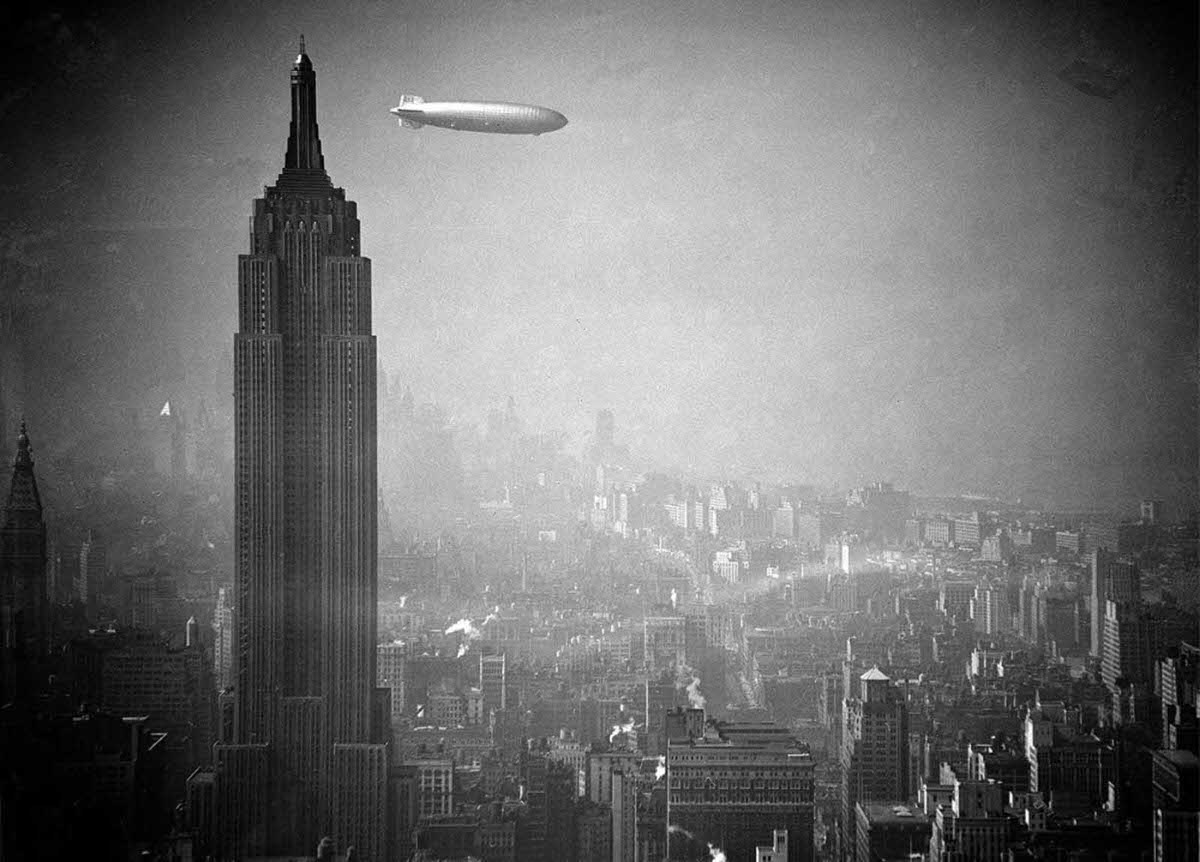
High above Manhattan, the German zeppelin Hindenburg drifts past the Empire State Building, turning the city’s sharp Art Deco silhouette into a stage for one of the 1930s’ most ambitious inventions. The airship hangs in the hazy sky like a polished capsule, its long form echoing the era’s fascination with speed, scale, and modern engineering. Below, the dense grid of rooftops and streets fades into atmospheric distance, emphasizing just how far New York’s skyline had already climbed.
August 8, 1936 sits within a brief window when lighter-than-air travel still promised a glamorous future, and this scene reads like a meeting of two competing visions of progress. The Empire State Building—built to dominate the skyline—stands immovable and vertical, while the Hindenburg glides with quiet confidence, suggesting that the next frontier might be above the city rather than within it. It’s a striking contrast: steel and stone anchored to the ground, and a vast aircraft designed to cross oceans.
For historians and image-lovers alike, this historical photo offers more than spectacle; it’s a reminder of how quickly technology can feel inevitable, then suddenly become a chapter instead of a destination. The Manhattan skyline appears both familiar and distant, a bustling metropolis seen through the soft grain of the period, while the airship provides a singular focal point for anyone searching for “Hindenburg over Manhattan” or “Hindenburg Empire State Building 1936.” In one frame, invention, aspiration, and urban identity converge—an airborne visitor passing a tower built to last.