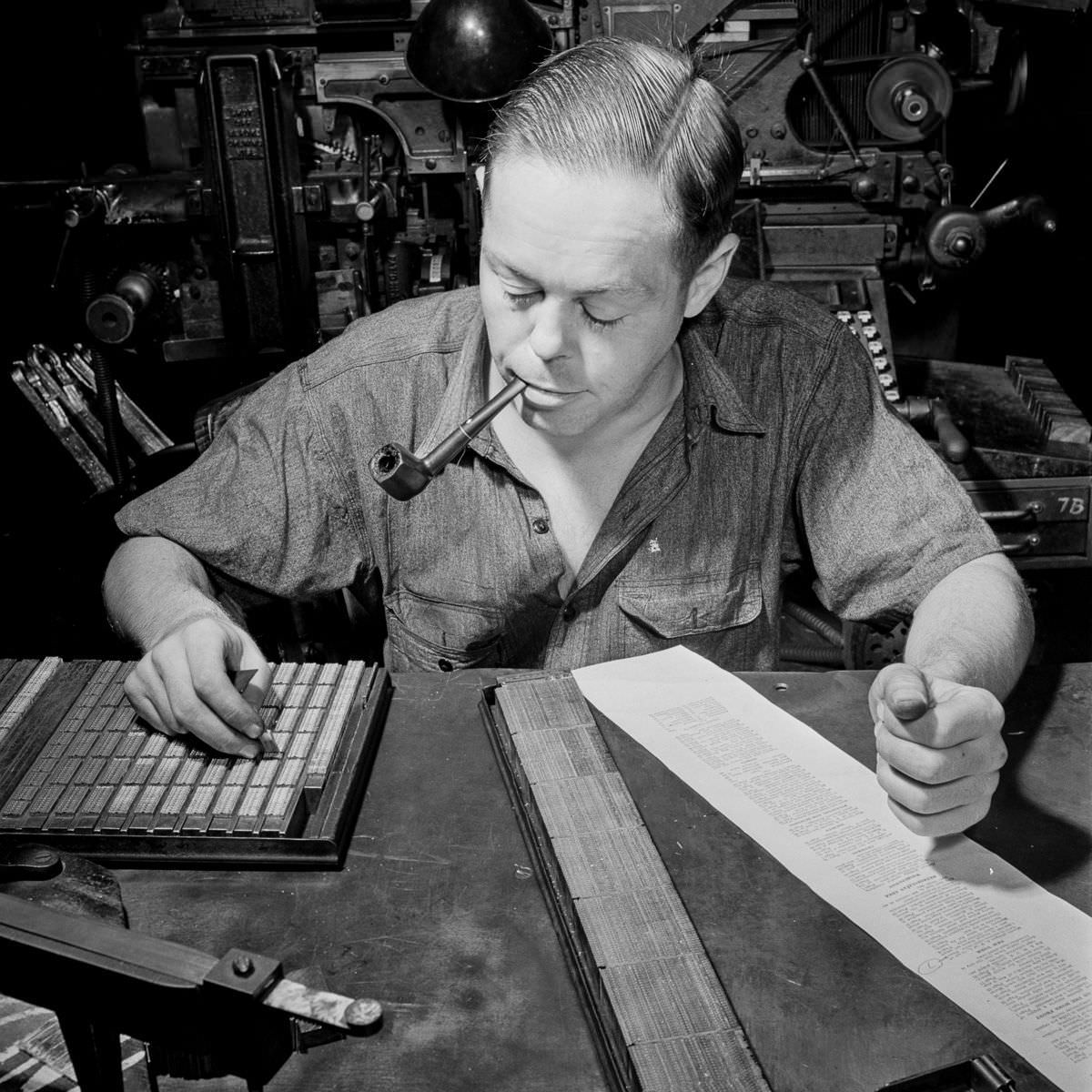
Under the glow of a work lamp, a seasoned compositor leans in with the quiet concentration of someone who knows every drawer and groove of the trade. A pipe rests at the corner of his mouth as his hands hover over a type case, selecting tiny metal letters one by one while a long, narrow proof on the table waits to be checked. Behind him, the dense machinery of the print shop frames the scene—gears, knobs, and metal housings that hint at the constant hum of production just out of earshot.
The title points to a routine that once shaped how readers navigated a newspaper: the daily index to the news, assembled partly by hand even as mechanical systems expanded around it. That mix of invention and tradition is written into the photo itself—precision work at arm’s length, heavy equipment close enough to touch, and the steady posture of a worker who has done this for fifteen years. It’s a reminder that “setting type” was not only an industrial process but also a craft, built on repetition, memory, and an eye trained to spot the smallest error.
For anyone interested in printing history, composing rooms, and the evolution of newspapers, this image offers a tactile look at how information became readable before digital layout and automated typography. The arranged compartments of type, the proof strip, and the careful hand placement speak to a world where speed depended on skill, and accuracy depended on patience. Seen today, the photograph doubles as an artifact of workplace culture—where tools, machines, and human focus combined to turn breaking news into ink on paper.