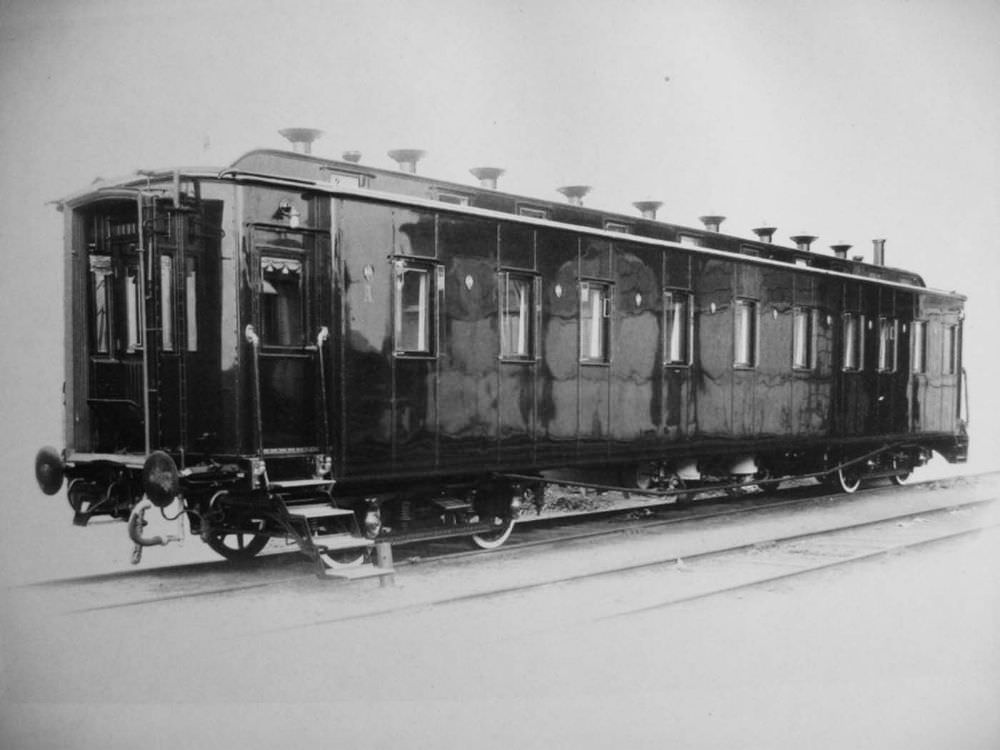
A lone railway carriage sits on the track like a polished piece of machinery, its dark bodywork interrupted by a neat row of windows and roof vents. The enclosed end platforms, sturdy buffers, and visible undercarriage details hint at the practical engineering that kept early rail travel safe, stable, and serviceable. Even without a bustling station around it, the vehicle carries the quiet authority of a train built to endure long miles and hard seasons.
Russian railway history is often told through sweeping routes and famous lines, yet everyday rolling stock like this passenger car shaped the experience of movement just as much. The design suggests a period when comfort, ventilation, and compartmental organization were becoming central to passenger service, while construction remained unmistakably utilitarian. Small exterior fittings and the carriage’s proportions point to a time when rail technology was rapidly standardizing—an “inventions” story told in rivets, wheels, and metalwork.
For readers interested in vintage trains, industrial heritage, or the evolution of public transport, the photo offers a clean, close look at how railway cars were built before modern streamlined styling took over. It invites questions about class divisions inside the compartments, heating and lighting methods, and how such cars fit into larger consists behind steam locomotives. As a historical image of a train on the Russian railway, it reminds us that progress often arrives not as a single breakthrough, but as a series of careful improvements rolling forward on steel rails.