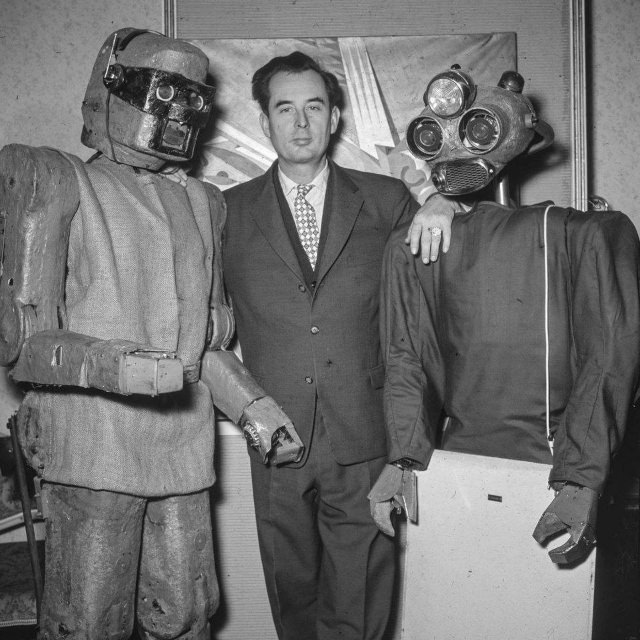
Between two bulky, homemade-looking “robot” figures, inventor Claus Scholz-Nauendorff poses in a suit with the calm confidence of a man selling the future. The scene has the feel of a demonstration or press moment: one mechanical companion looms at left with a boxy head and heavy arms, while the other, at right, wears a goggle-eyed mask of lenses that suggests sensors, sight, or some early idea of machine perception. Even without motion on the page, the photo conveys ambition—an era when robotics and domestic technology were becoming part of everyday imagination.
The title points to the MM7 Selektor Robot, a name that sounds both industrial and strangely intimate, as if built for the factory and the household at once. Details in the image hint at practical construction—thick joints, sturdy casings, and protective coverings that imply durability over elegance—matching the mid-century fascination with labor-saving inventions. Housework, long framed as repetitive and time-consuming, became a testing ground for innovation, and “selektor” evokes the promise of choice: a machine that could identify tasks, tools, or sequences rather than merely repeat a single motion.
Curiosity is what makes this historical photo linger, not just the robots’ theatrical presence but the human figure anchoring the spectacle in reality. It’s a snapshot of the optimism that surrounded early home automation and robot invention, when mechanical helpers were imagined as the next step in modern living. For readers searching topics like “MM7 Selektor Robot,” “Claus Scholz-Nauendorff,” or “revolutionizing housework,” this image offers a compelling window into how inventors once staged the future—one demonstrator, two experimental machines, and a world ready to believe in smarter domestic life.