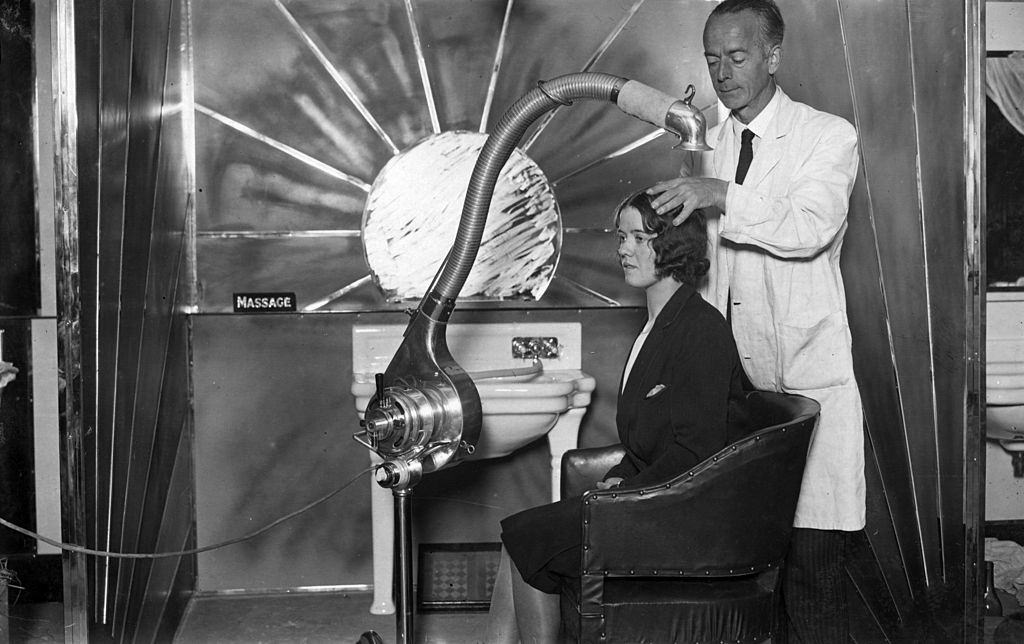
Inside a sleek, metal-walled salon cubicle, a seated woman waits while a stylist in a white coat positions an early, hose-fed hair dryer above her carefully waved bob. The machine looks more like workshop equipment than a beauty tool: a heavy motor unit on a stand, a flexible duct arcing toward the head, and a gleaming nozzle meant to direct heated air with precision. Even the surrounding fixtures—sink, chair, and reflective panels—echo the era’s faith that modern design could tame time, labor, and appearance.
Oddball hair dryer models from 20th-century inventions often borrowed their language from industry, medicine, and domestic engineering, and the result could be both futuristic and faintly intimidating. Before compact handheld dryers became common, salons relied on bulky contraptions that promised speed, consistency, and the kind of “scientific” treatment that customers associated with progress. In photos like this, the ritual of hairdressing becomes a small performance of technology, with the client framed as much by apparatus and chrome as by fashion.
Looking back, these bizarre hair dryer designs reveal how beauty culture and consumer tech grew together, one experiment at a time. The exposed mechanics, oversized ducts, and purpose-built stations hint at a period when inventors and manufacturers were still negotiating what a hair dryer should be: powerful, safe, comfortable, and affordable. For readers hunting vintage salon history, retro beauty gadgets, or the evolution of hair dryers through the 20th century, this snapshot is a reminder that today’s quiet plastic tools have surprisingly theatrical ancestors.