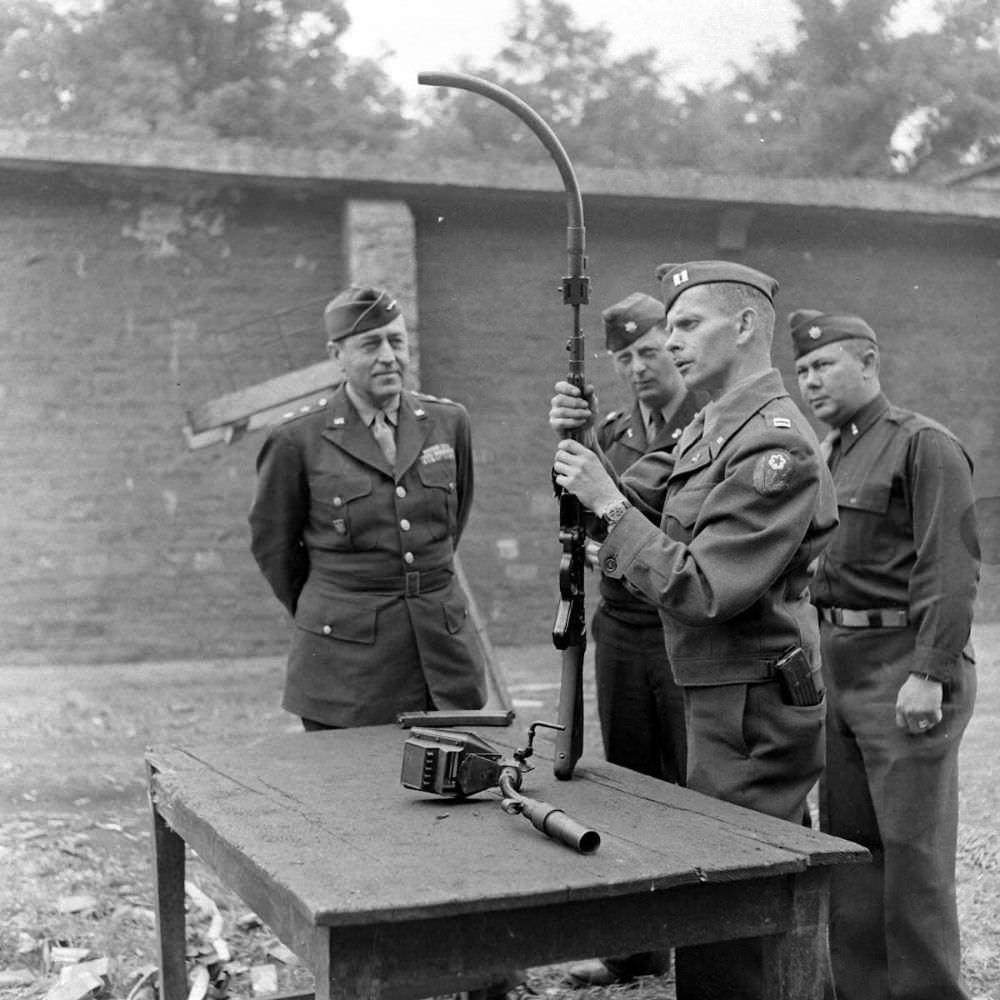
A small group of uniformed men gathers around a rough wooden table as one of them carefully holds up an oddly bent firearm attachment, its barrel curving like a hooked cane. The scene feels part demonstration, part inspection—faces attentive, posture formal—while a few additional components lie on the tabletop as if ready for explanation. Even without captions, the strange geometry of the device dominates the frame, telegraphing a wartime obsession with pushing engineering beyond what seemed possible.
The post’s title points to the Krummlauf, a Second World War-era experiment that tried to solve a brutal battlefield problem: how to fire from cover or around corners without exposing the shooter. By redirecting a projectile through a curved section of barrel, designers aimed to create a “corner-shot” solution for close-quarters fighting, trenches, and urban rubble where sightlines were deadly. It’s an invention that reads almost like science fiction, yet the photograph reminds us it was treated as a serious piece of military hardware, tested and handled under watchful eyes.
What makes the Krummlauf story so compelling is the gap between bold idea and unforgiving physics—curving a shot comes with punishing wear, reduced accuracy, and the constant risk of failure. Photos like this invite readers to look closely at the practical details: the modified muzzle, the accessories on the table, and the cautious way the device is presented, as though everyone present knows it could be as temperamental as it is ingenious. For anyone searching WWII inventions, experimental weapons, or the real history behind “bending bullets,” this image opens a window into the era’s improvisation, urgency, and relentless trial-and-error.