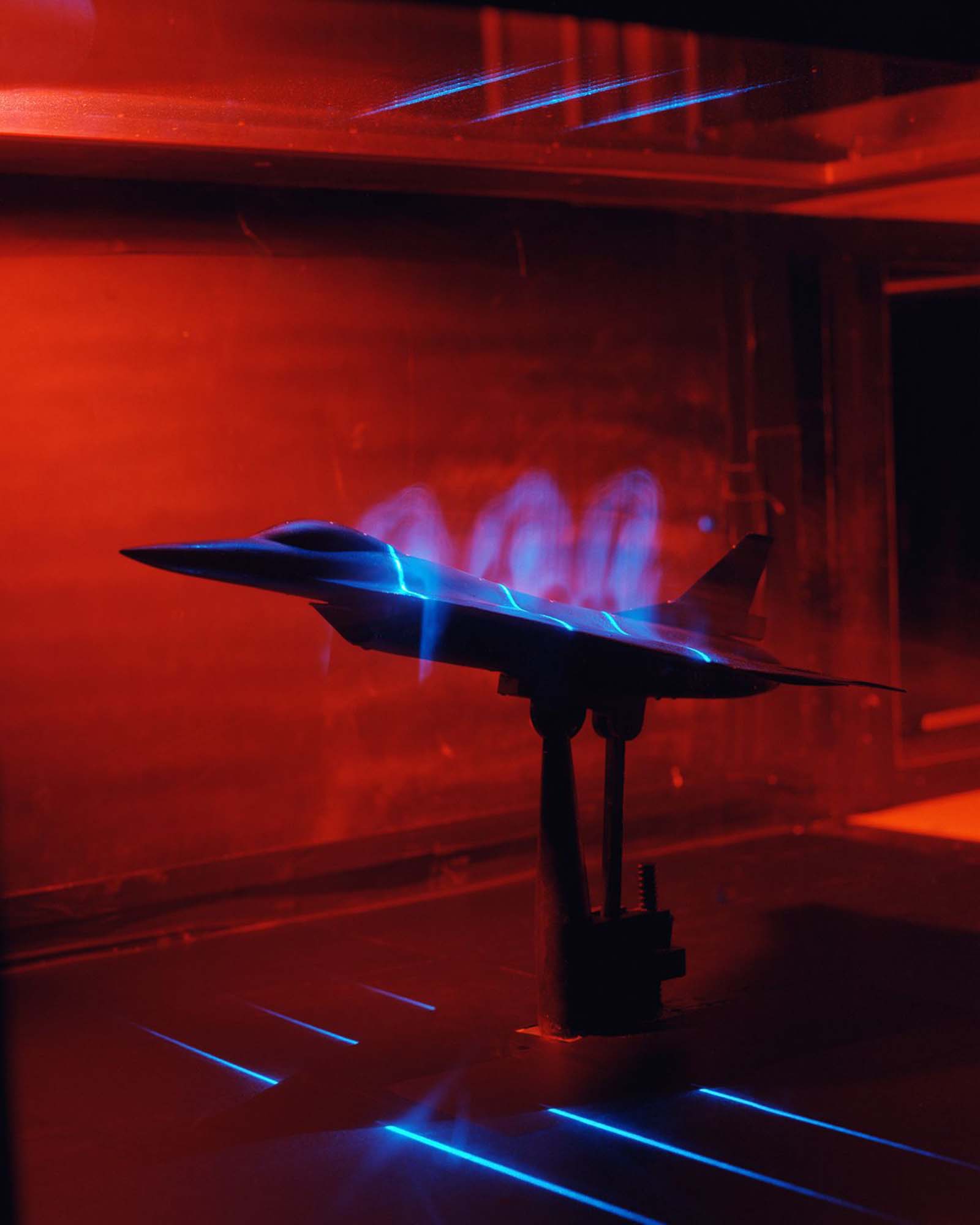
Bathed in a deep red glow, a scale model of an F-16 sits poised on its test stand while a razor-thin blue laser light sheet slices across the air around it. The setup turns the invisible into something almost theatrical: smoke particles catch the light and trace luminous lines that cling to the fuselage and sweep over the wings, hinting at the aerodynamic forces engineers work to master.
Flow visualization like this—using smoke and laser illumination—has long been a crucial tool in wind-tunnel research, and by 1992 it was an established bridge between hands-on experimentation and increasingly sophisticated computer analysis. The photo’s crisp streaks and faint eddies reveal where airflow stays smooth and where it begins to separate or curl into vortices, the very behaviors that can affect stability, control, and performance in a fighter aircraft design.
Beyond its striking color and contrast, the image is a reminder that aviation progress often depends on careful measurement as much as daring flight. For readers interested in the history of aerospace engineering, wind tunnel testing, and aerodynamic research methods, this scene captures a moment when smoke, lasers, and meticulous observation helped refine how an F-16-shaped airframe meets the air.