A bold 1932 headline promises a future where “Smoking Now No Effort at All,” and the accompanying clipping reads like a sales pitch for modern convenience. The article describes an electric desk dispenser designed to deliver a single cigarette “fully lighted and ready to smoke,” turning an everyday habit into a push-button novelty. Even the phrasing—half wonder, half certainty—echoes the era’s faith that electrification could streamline nearly everything.
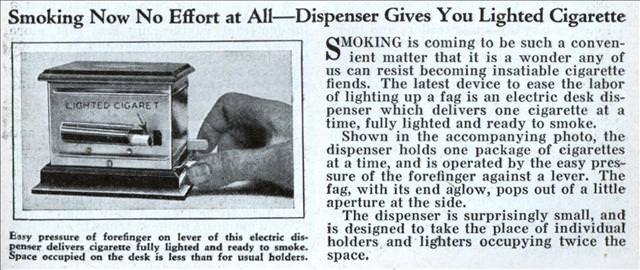
In the inset photo, the compact box sits like a small office gadget, with labeling that emphasizes the startling feature: “LIGHTED CIGARET.” According to the text, a pack is loaded into the device and a finger press on a lever triggers the mechanism, causing a glowing cigarette to pop out through a side aperture. The copy lingers on practicality, claiming it saves space and replaces separate holders and lighters—an early example of the all-in-one “convenience appliance” mentality.
Seen today, this invention reads as both an artifact of interwar innovation and a revealing snapshot of how smoking was marketed as effortless, efficient, and even futuristic. For readers interested in 1930s inventions, vintage advertising language, and the history of everyday technology, the clipping offers a crisp window into the period’s imagination. It also underlines how design and electricity were enlisted to remove friction from daily routines—sometimes in ways that feel surprising now.