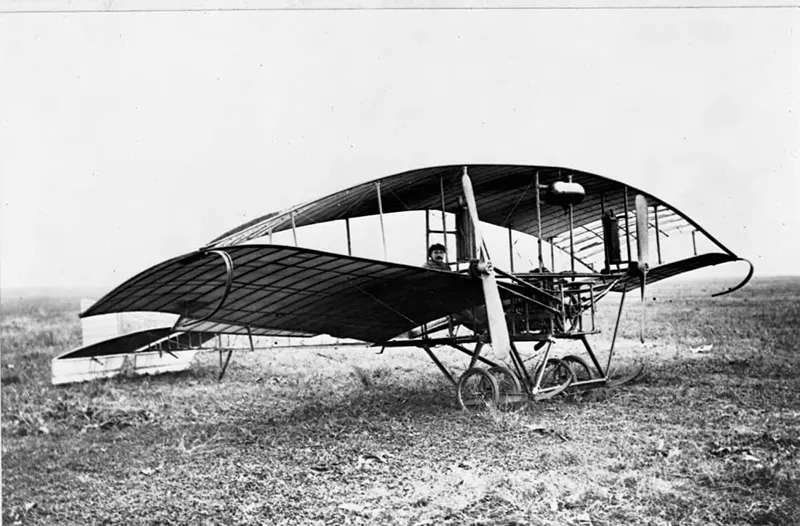
Low to the ground on a rough field, an experimental biplane rests with the calm poise of a machine still earning its place in the sky. The airframe’s layered wings stretch wide and slightly arched, their ribbed structure plainly visible, while a network of struts and wires holds everything in tense, purposeful alignment. Even at a standstill, the craft suggests the restless ingenuity behind early aviation inventions—part bicycle, part kite, part bold hypothesis.
Behind the forward supports, the pilot sits exposed within an open framework, surrounded by the practical minimalism of early flight design. A single propeller stands at the nose, and the undercarriage looks lightweight and spidery, built more for experiments than comfort. Details like the delicate wheels and the sparse cockpit area underline how much of pioneering flight depended on faith in engineering and nerve, not yet on standardized safety or refined aerodynamics.
Seen today, the photograph reads as a quiet document of innovation: a moment when aviation was still a workshop idea translated into wood, fabric, and wire. For readers interested in historical aircraft, experimental biplanes, and the broader story of inventions that reshaped the modern world, this image offers a direct connection to that era’s hands-on problem solving. It invites a closer look at how early pilots and builders tested possibilities—one field, one machine, and one attempt at a time.