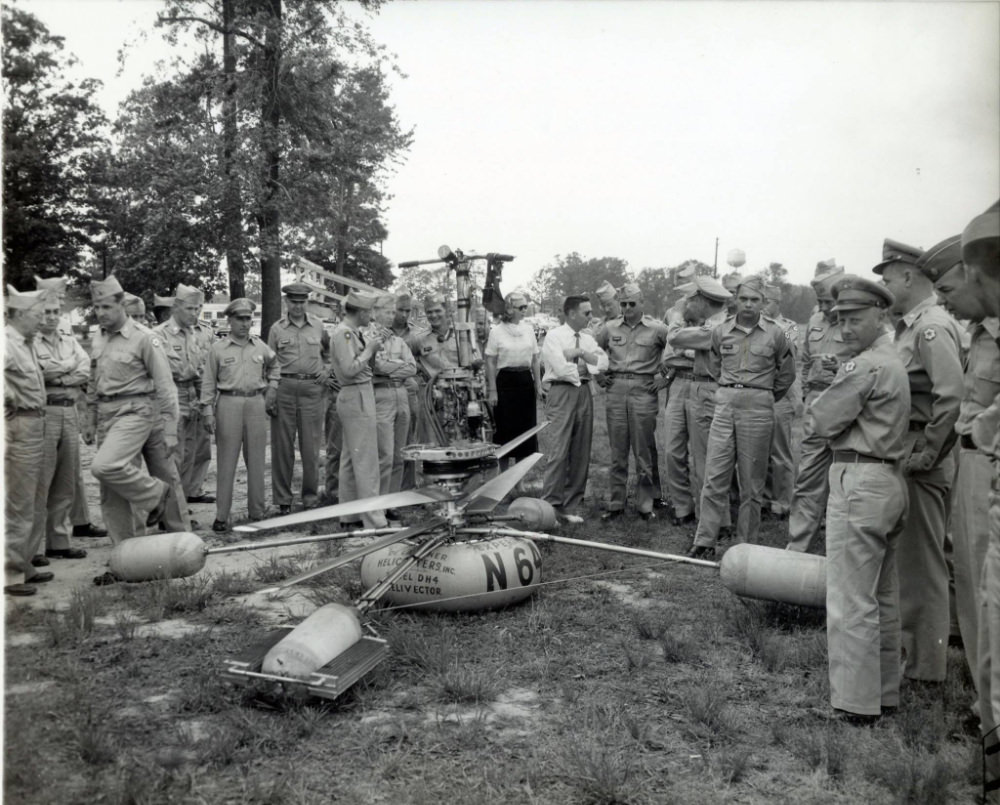
A ring of uniformed onlookers crowds an open patch of grass, their attention fixed on a strange, low-slung flying machine that looks part helicopter, part oversized toy. At the center sits the de Lackner HZ-1 Aerocycle—an audacious “one-man personal helicopter” concept—its metal framework, exposed mechanics, and wide rotor assembly laid bare for everyone to study. The scene has the feel of a demonstration that has paused mid-story, with the compact craft grounded while observers take in what the future of individual flight was supposed to become.
Closer details underscore just how experimental the Aerocycle was in the 1950s: a minimalist platform, stabilizing pontoons, and a small body bearing markings that hint at official testing and serial identification. Instead of a sleek fuselage, everything is out in the open—engine, controls, and structure—suggesting a design built for function and proof-of-concept rather than comfort. Faces in the crowd range from curiosity to skepticism, capturing the tense gap between bold engineering promise and the practical realities of keeping a lone rider safe in the air.
The title’s mention of a failed flight test gives the photograph its edge, turning a tech showcase into a cautionary chapter in aviation history. Projects like the HZ-1 Aerocycle belonged to an era fascinated by personal mobility and battlefield innovation, when inventors and planners imagined soldiers—or civilians—lifting off on compact rotorcraft with minimal training. For readers drawn to Cold War experimentation, retro inventions, and the early search for personal aircraft, this image preserves a moment when the dream of a personal helicopter met the hard limits of stability, control, and risk.