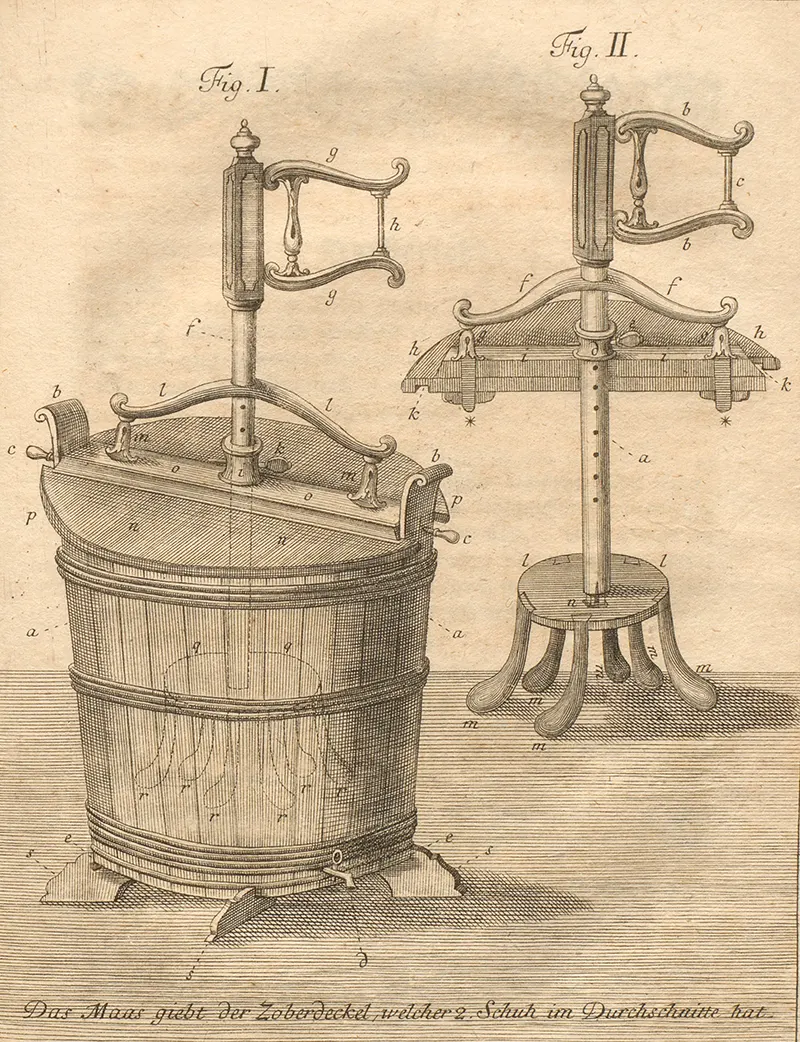
Ink lines and careful crosshatching turn this 1766 illustration of Schäffer’s washing machine into a persuasive argument for ingenuity. Two labeled figures present the device like a demonstration for curious readers, balancing decorative flourishes with the plain logic of parts marked by letters. Even on aged paper, the precision feels modern: a technical drawing meant to be built, tested, and improved.
At the center sits a stout wooden tub bound with hoops, paired with a vertical shaft and a crank-like handle that suggests rotary motion to agitate laundry inside. The companion view shows a stand-mounted version, lifting the mechanism away from the barrel and making the moving elements easier to study. Small details—hinges, braces, and fastenings—hint at how the designer tried to translate hard household labor into controllable mechanical work.
Pages like this belong to the wider story of early domestic technology, when inventors chased efficiency long before electricity reached the laundry room. Schäffer’s washing machine illustration, 1766 speaks to a period fascinated by devices that could standardize everyday tasks and reduce drudgery through clever leverage. For readers searching for historical inventions, early washing machines, or eighteenth-century engineering drawings, this image offers a crisp window into the origins of mechanized cleaning.