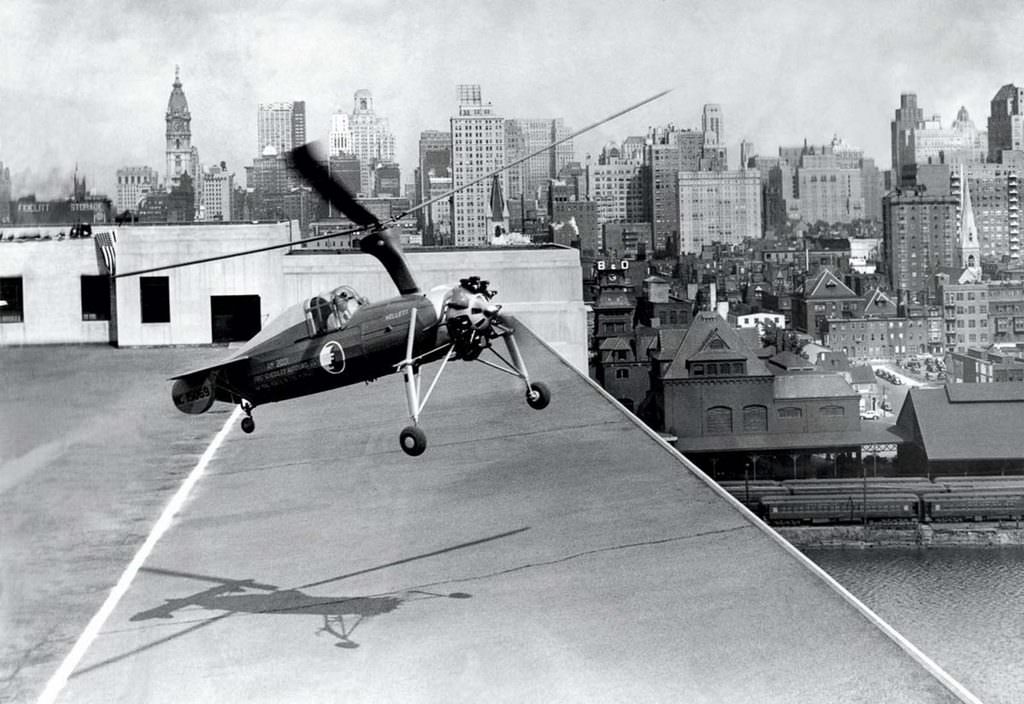
High above Philadelphia’s streets, an autogyro lifts away from a flat rooftop, its rotor a dark blur against a hazy skyline. The aircraft’s spindly landing gear and compact fuselage look almost improvised, yet the moment feels carefully staged—an experiment in making the city itself a runway. In the background, dense blocks of buildings and distinctive towers anchor the scene in an era when downtown silhouettes still read like a catalogue of civic ambition.
Rooftop aviation promised a future in which short-hop air travel might slip easily into everyday life, bypassing distant airfields and congested roads. The autogyro—part airplane, part rotorcraft—symbolized that in-between stage of invention, when engineers tested what was possible before the helicopter became the dominant vertical-flight idea. Seen here in 1930, the machine’s lift-off suggests both daring and practicality: a controlled departure from a confined space, framed by the geometry of the roof’s edge.
Between the riverfront buildings and the clustered roofs below, the photograph also preserves a snapshot of interwar urban modernity, when new technology was marketed as spectacle and solution at once. It’s an image made for readers who love early aviation, the history of inventions, and the evolving relationship between cities and flight. As a historical photo of an autogyro taking off from a Philadelphia rooftop, it captures the optimism—and the risk—of turning tomorrow’s transportation into today’s headline.