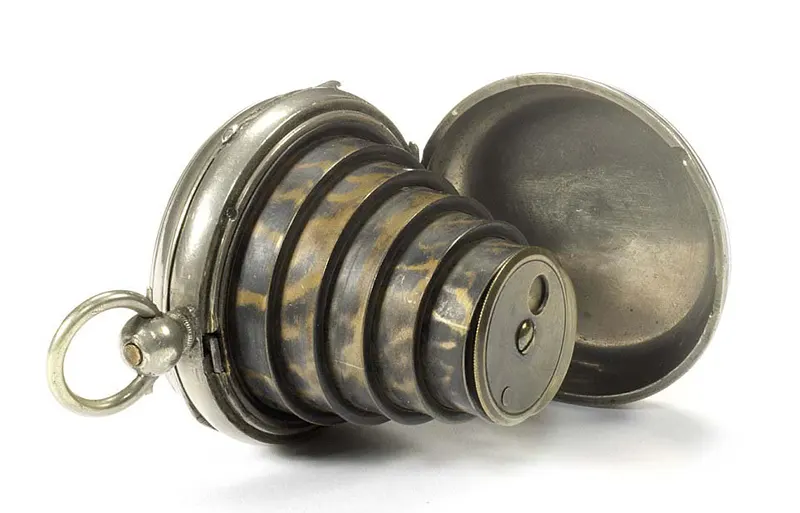
Small enough to disappear into a gloved hand, the “ladies’ pattern” patent watch camera feels like a clever contradiction: jewelry on the outside, optics within. In the photo, its compact metal case opens like a pocket watch, revealing a collapsible bellows and a tiny lens plate—features designed to fold down for concealment and spring into readiness in an instant. Even without a bustling street scene around it, the object carries the quiet drama of portable technology becoming truly personal.
The title’s reference to a female agent in 1886 points to the era’s fascination with discreet observation and the growing market for miniature inventions. Devices like this were engineered to resemble ordinary accessories, letting the user blend into polite society while still recording what she saw. That mix of fashion and function speaks to a world where surveillance, journalism, and private curiosity all benefited from cameras shrinking into everyday forms.
For readers interested in early photography, Victorian gadgets, and the history of inventions, this watch camera offers a striking example of how design served secrecy as much as style. The visible bellows suggest a serious photographic mechanism tucked into a familiar silhouette, highlighting the ingenuity required before modern compact cameras existed. It’s an artifact that invites closer study—not only of how it worked, but of the social settings in which such a “hidden” camera could operate.