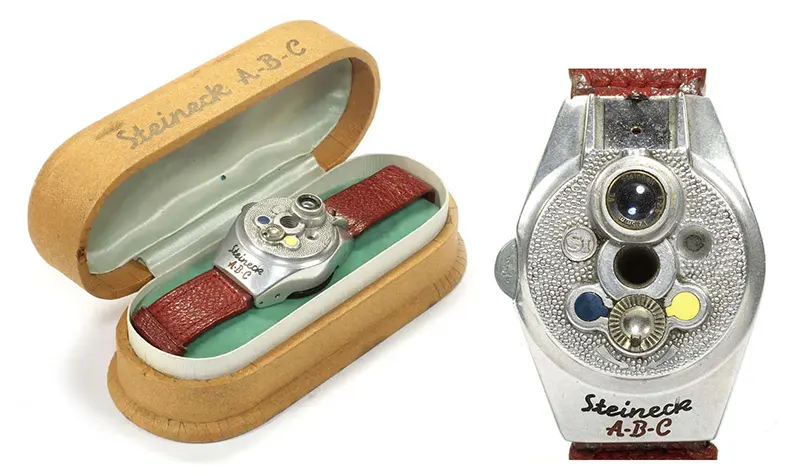
Few gadgets speak so clearly to postwar ingenuity as the ABC watch camera from 1948, a wristwatch-sized invention that hides a working camera inside an object meant for everyday wear. The photo shows the device nestled in its fitted case as well as a close-up of the watch body, where the lens is positioned on the back—an arrangement that kept the front face deceptively ordinary. Even at a glance, the compact metal housing, small controls, and leather strap hint at the era’s fascination with miniaturization and multifunction design.
Seen up close, the back of the watch becomes a tiny camera panel, with the lens and apertures clustered together among textured metalwork and color-marked indicators. That unusual placement suggests how the wearer would have had to think like both photographer and performer, aligning the wrist discreetly while operating minute dials and buttons. The branding visible on the case and body reinforces that this wasn’t a mere novelty, but a carefully made piece of precision engineering meant to be carried—and potentially used—anywhere.
Collectors and history buffs often place watch cameras in the broader story of early wearable technology, long before the term existed. Devices like this sit at the crossroads of consumer electronics, surveillance lore, and mid-century industrial design, making them endlessly shareable for readers searching for “1948 watch camera,” “ABC watch camera,” or “hidden lens wristwatch.” As a historical artifact, it also invites questions about how people balanced curiosity, convenience, and privacy when cameras began shrinking enough to fit on a wrist.