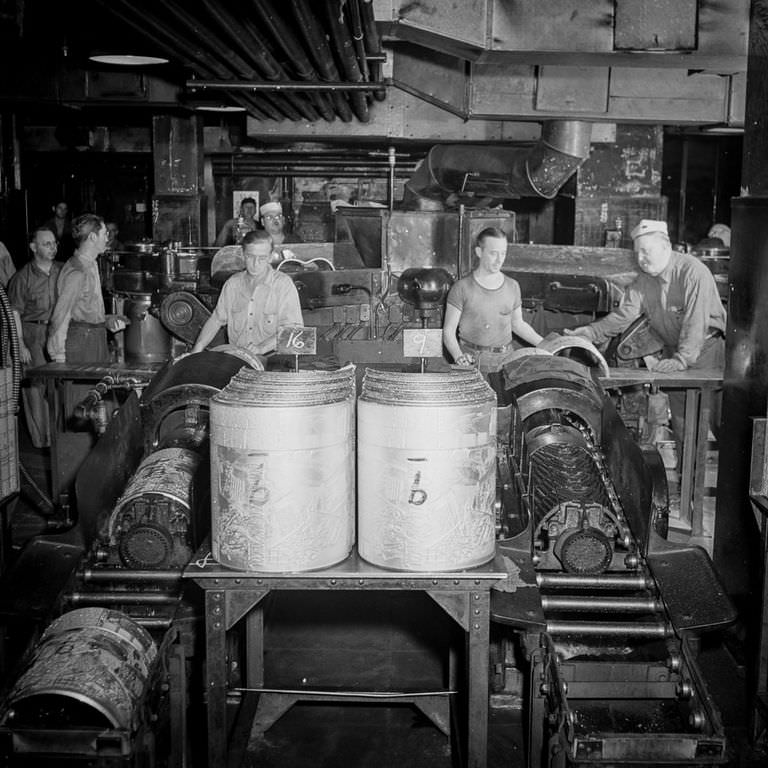
Steel frames, belt drives, and heavy rollers crowd the shop floor as a press crew prepares for the day’s run, pausing at the crucial moment when plates are loaded and aligned. In the foreground sit large cylindrical containers—ink or solution barrels—while numbered placards and tool-strewn surfaces hint at a tightly managed workflow. The men’s work clothes and caps fit the industrial setting: practical, close to the machinery, and focused on precision before motion turns everything fast and loud.
Loading plates into printing presses was the bridge between design and mass production, when careful hands and sharp eyes ensured the image would transfer cleanly once the press started rolling. The photograph conveys that mix of craft and engineering—operators checking clearances, handling curved components, and coordinating around a machine built for repetition. Overhead ducts and pipes emphasize the infrastructure that surrounded early industrial printing, from ventilation to power transmission.
For anyone interested in inventions and the history of printing, this scene highlights the hidden labor behind newspapers, packaging, and everyday ephemera that shaped modern communication. It’s a reminder that technological progress wasn’t only about new machines, but also about the routines that made them reliable: set-up, calibration, and teamwork. Long before digital workflows, the pressroom was where information became tangible—one plate, one run, one rolling start at a time.