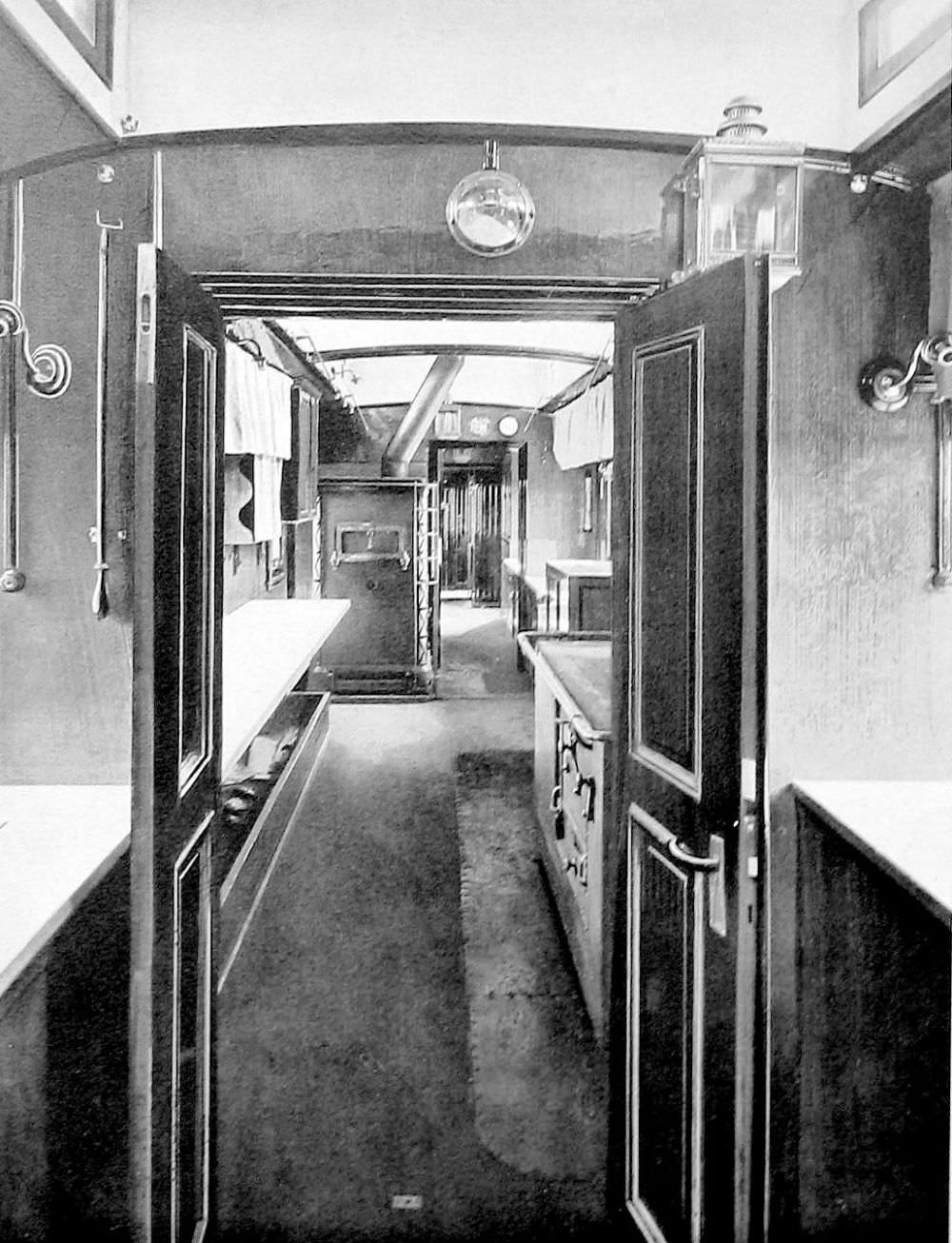
A narrow corridor stretches forward through a carefully fitted interior, where paneled doors stand open like invitations into compact compartments. The woodwork looks purposeful rather than ornamental, and the tight geometry of frames, rails, and partitions hints at a space designed to be efficient in motion—more like a carriage, coach, or vessel than a stationary home. Overhead, small fixtures and a globe-like lamp punctuate the ceiling, adding to the sense of early modern convenience.
Details reward a slow look: hooks and hardware on the doors, curtained openings along the sides, and built-in cabinets that make the most of every inch. A metal stove or heater sits farther down the passage, its flue rising toward the roof—an everyday invention that made travel and work in confined spaces far more tolerable. Even the flooring shows the wear of routine footsteps, suggesting this was a lived-in working environment as much as a designed one.
“Interior” becomes more than a simple title here; it’s a window onto how technology and craftsmanship met in practical, human-scale design. For readers interested in inventions, historical engineering, and the evolution of transport interiors, the photograph offers a quiet catalogue of solutions—portable heat, smart storage, and durable finishes—arranged in a remarkably orderly line. The result is a scene that feels both familiar and distant, reminding us how comfort was built, measured, and maintained long before today’s standard amenities.