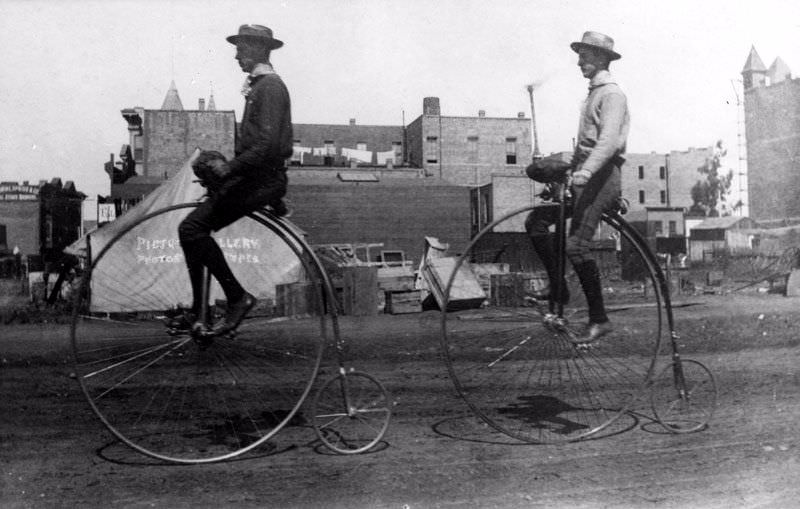
Tall wheels dominate the street as two riders balance high above the ground on penny-farthings, their posture steady and their hats set against the open sky. Behind them, low buildings and distant rooftops form a rough-edged city backdrop, while the oversized front rims and spidery spokes create a striking silhouette that instantly signals the early age of cycling inventions. The contrast between the riders’ calm expressions and the precarious height of their machines hints at the skill—and nerve—required for everyday travel on such designs.
In an era before modern gearing and safety bicycles, the penny-farthing turned speed into a matter of wheel diameter, lifting the cyclist into a world where every mount, turn, and stop carried consequence. Details in the photograph—thin tires, narrow frames, and the unmistakable difference between the giant driving wheel and the much smaller rear—underscore how experimental and purposeful these early bicycles were. For anyone searching for vintage cycling photographs, this scene offers a clear window into the engineering choices that shaped the sport and the street alike.
Beyond the mechanics, there’s a social story here: ordinary urban space temporarily becomes a stage for modernity, where riders and onlookers would have measured progress in spinning metal and confident balance. The image invites reflection on how quickly transportation changed, from daring high-wheelers to the practical bicycles that followed, and how photography preserved those fleeting moments of innovation. As a timeless record of the penny-farthing era, it connects today’s cycling culture to the ingenuity—and risks—that once defined getting from one block to the next.