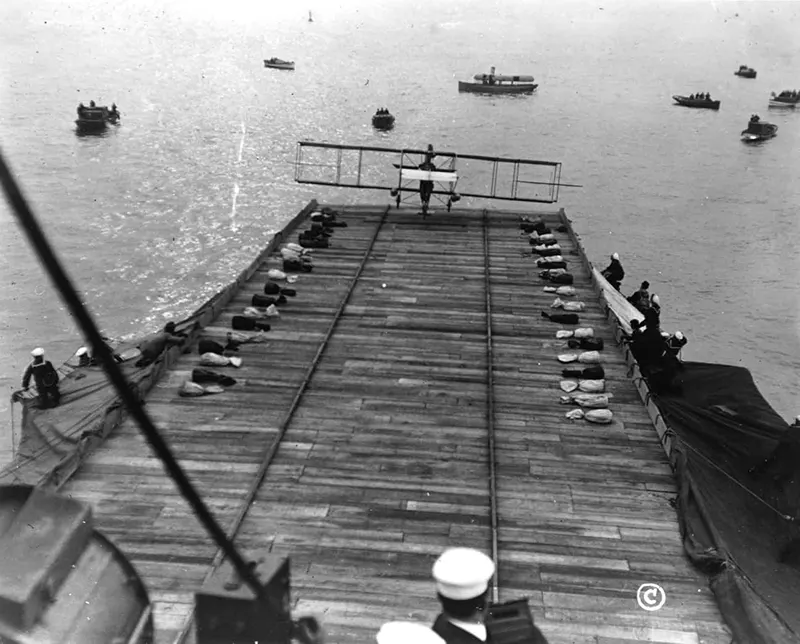
High above the broad, glittering water, a biplane lines up with a narrow wooden platform built atop the USS Pennsylvania, turning a battleship into an improvised airfield. The aircraft’s stacked wings and spindly landing gear look delicate against the ship’s hard geometry, while small boats hover in the background like curious spectators. It’s a striking snapshot of early naval aviation, when flight at sea was still a daring experiment rather than routine procedure.
Along the edges of the deck, sailors in light uniforms crouch and stand at attention, their spacing suggesting a planned operation and a readiness to grab lines or clear obstacles in an instant. Sandbags or bundled gear appear arranged in rows, hinting at the practical measures used to stabilize equipment and protect the deck during these trial landings. The composition pulls the eye straight down the landing surface to the aircraft, emphasizing just how little margin for error existed when a biplane touched down on a warship.
Few scenes illustrate the spirit of “Inventions” quite like this one, where ingenuity bridged the gap between battleships and airplanes years before modern aircraft carriers dominated the oceans. For readers searching naval history, the USS Pennsylvania, or the evolution of deck-landing techniques, this photo offers a vivid look at the transitional era when engineers and crews tested what was possible with wood planks, manpower, and nerve. The moment feels both practical and audacious—an early proof that sea power was about to take to the air.