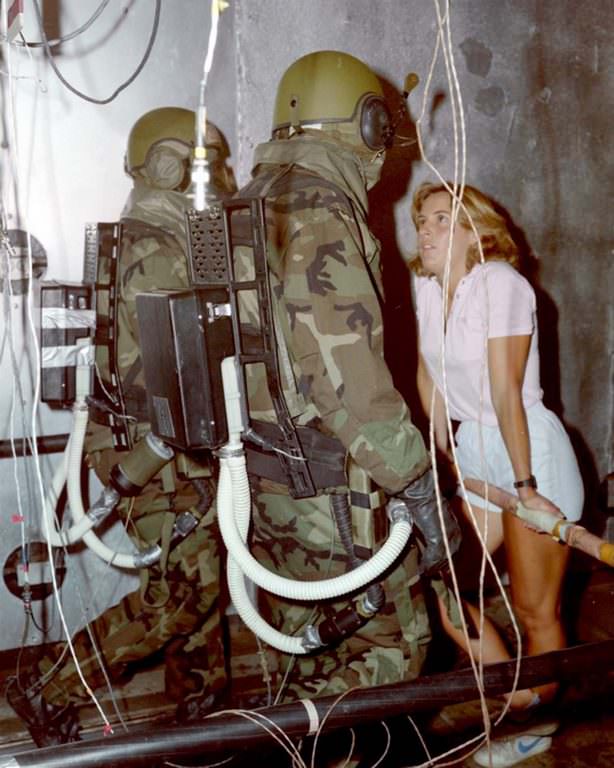
Deep inside a stark test chamber, two suited figures stand tethered to bulky backpack units, their helmets and hoses turning the room into a tangle of life-support lines and instrumentation. The camouflage fabric, rigid gloves, and sealed headgear suggest a controlled environment where heat, humidity, and airflow were variables to be measured rather than endured. Against the plain walls and exposed wiring, the technology itself becomes the main character—hard-edged, experimental, and unmistakably of its era.
At the right edge of the scene, a woman in everyday clothing leans in close, seemingly speaking to the suited personnel or observing a procedure at arm’s length, giving the moment a human scale. Her presence underscores that this was a study as much about people as about machines: how the body performs under stress, and what engineering could do to keep workers or responders functional in punishing conditions. The contrast between casual attire and heavy protective gear highlights the boundary between normal air and whatever atmosphere the chamber was built to simulate.
Titled “Tropic chambers micro-cooling study, 1985,” this photo points to a chapter in 1980s invention culture where climate testing and wearable cooling systems were practical necessities, not futuristic luxuries. The modular packs and connected tubing hint at early efforts to manage heat load through micro-cooling, a precursor to later advances in protective suits, hazardous-environment operations, and thermal management research. For readers searching topics like tropic chamber experiments, micro-cooling technology, or historical protective equipment, this image offers a vivid snapshot of applied science in progress.