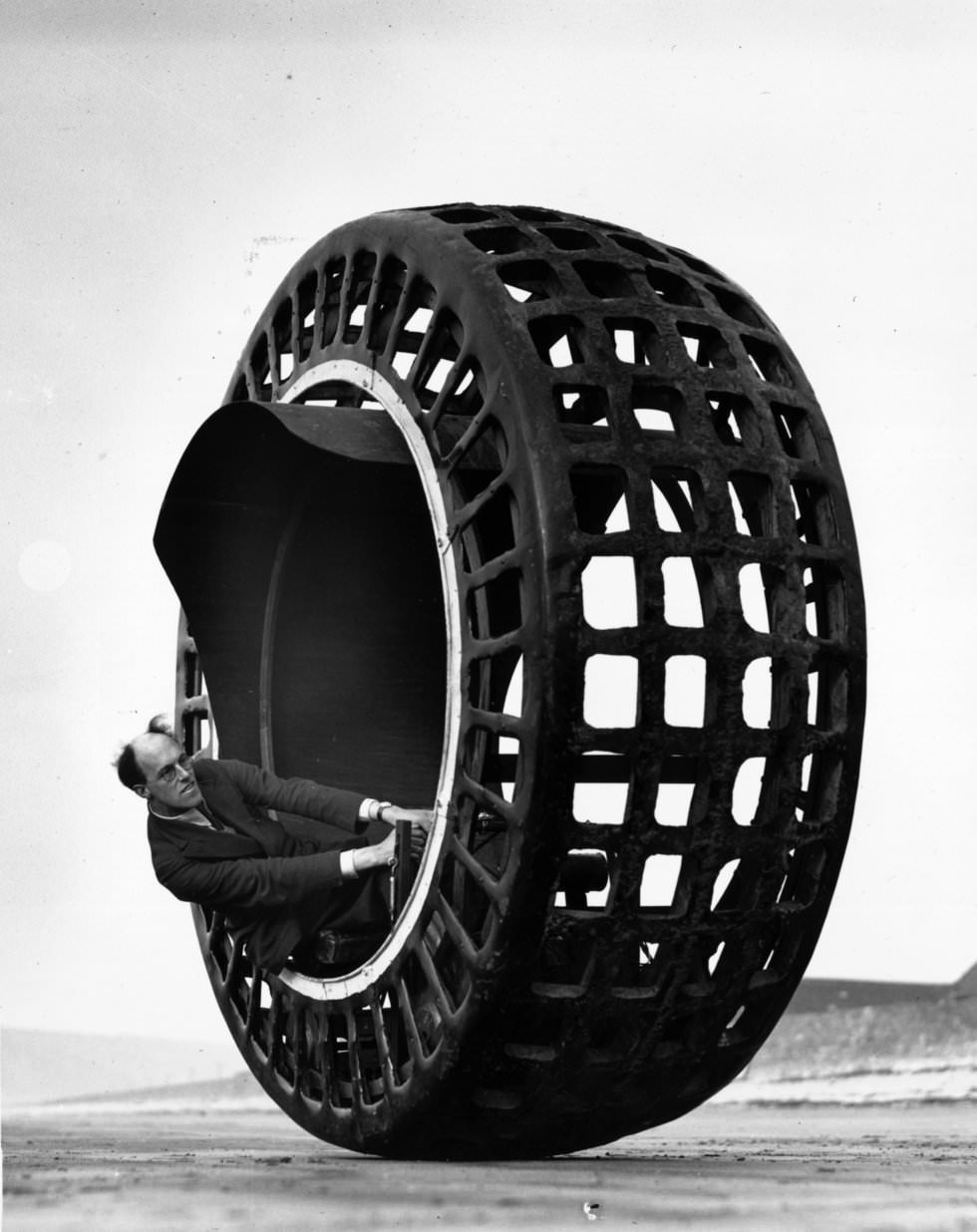
A single man leans forward at the controls of a peculiar one-wheeled vehicle, enclosed inside a giant open-lattice drum that looks more like industrial sculpture than transport. The title “Dynasphere” hints at the ambition behind this invention: to put the driver within the wheel itself, turning motion and enclosure into the same bold idea. Even in a stark, uncluttered setting, the machine’s scale is unmistakable, dwarfing its operator and emphasizing the risk-and-reward drama of experimental engineering.
What makes the Dynasphere so striking is the way it reimagines balance, traction, and steering in one compact concept—no separate front axle, no conventional chassis, just a rolling ring with a cockpit tucked inside. The grid-like outer structure suggests an attempt to keep weight down while maintaining strength, and the large opening frames the driver like a stage, inviting onlookers to wonder how it starts, stops, and turns without tipping. As a snapshot of early inventive culture, it speaks to a period when radical prototypes could be built full-size and tested with little more than confidence and mechanical intuition.
For readers browsing inventions and odd vehicles, this historical photo offers a memorable reminder that “future transport” has been proposed in many forms, not all of them destined for the road. The Dynasphere stands at the crossroads of creativity and practicality, a captivating detour in the story of mobility that still inspires designers, tinkerers, and historians today. Whether viewed as a daring solution or a glorious dead-end, it remains a powerful image for anyone interested in experimental engineering, vintage technology, and the wilder chapters of transportation history.