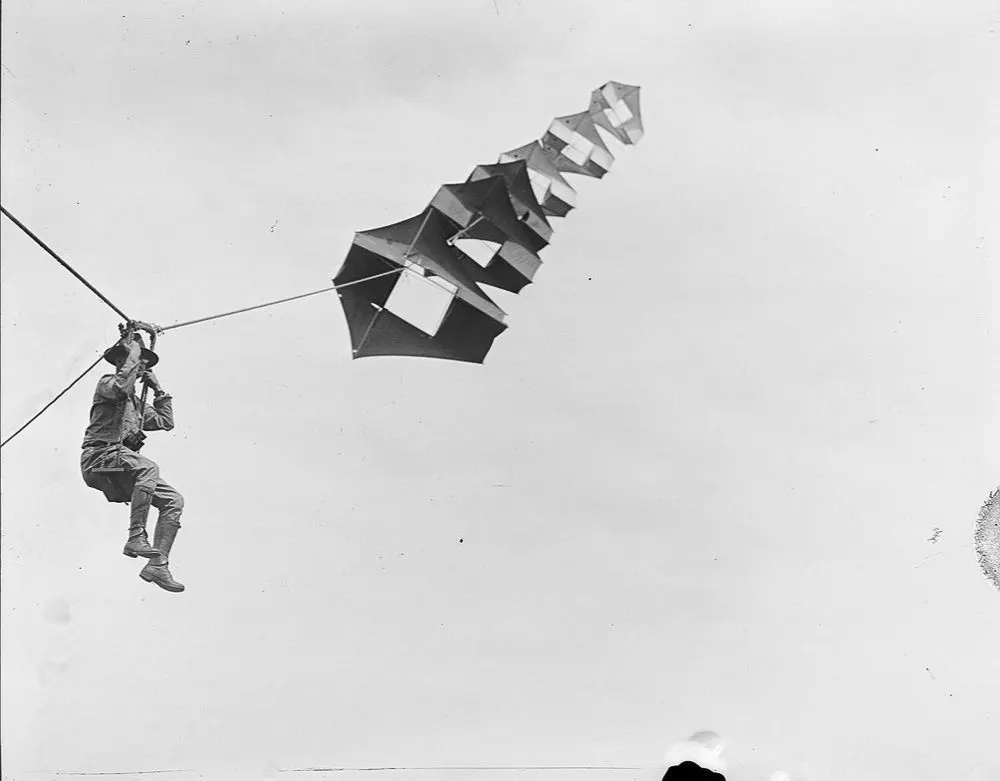
High above an empty sky, a lone observer hangs from a taut line while a train of boxy kites pulls steadily into the wind. The scene feels both daring and methodical: boots dangling, hands locked on the rigging, the flyer suspended in a crude but purposeful harness. With almost nothing in the background to distract the eye, the photograph centers on the audacious simplicity of man-lifting kites—airborne platforms built from fabric, spars, and nerve.
Before airplanes and dependable radios reshaped the battlefield, aerial reconnaissance often relied on whatever could climb into the air and stay there. Multi-kite systems like the one pictured were engineered for lift and stability, using a series of connected cells to keep the pull smooth as conditions changed. From that precarious perch, a spotter could scan terrain, track movement, and relay observations—an early attempt at gaining the “high ground” through invention rather than elevation.
What makes this technology so fascinating is how it bridges eras: part maritime rigging, part experimental aviation, and part military improvisation. The image captures the practical logic behind the design—distributed lift, long lines, and a human payload treated almost like additional equipment—while also hinting at the risk involved in every ascent. For readers exploring the history of man-lifting kites, this photo offers a vivid doorway into a forgotten chapter of aerial observation, when wind and craftsmanship briefly rivaled engines as tools of surveillance.