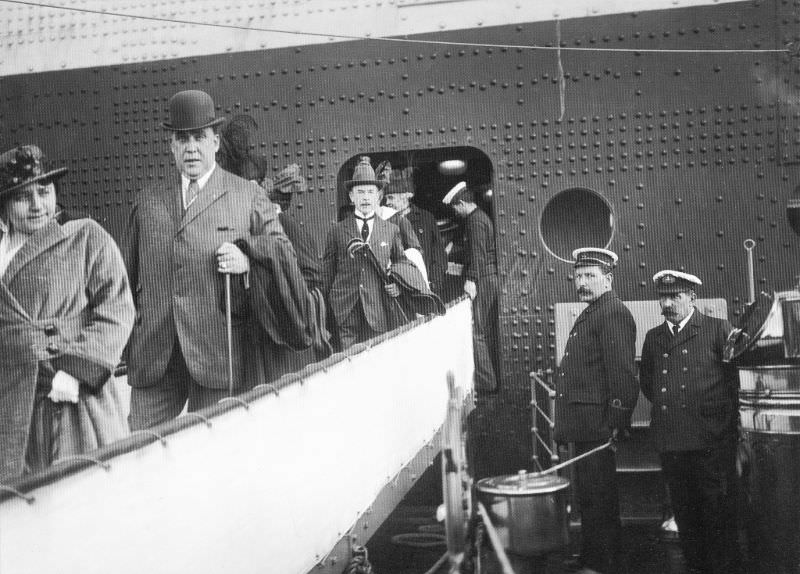
Riveted steel fills the background like a wall, broken only by a low doorway where travelers emerge in sequence, pausing before stepping onto the tender at Fishguard. The gangway’s pale railing leads the eye along a small procession: a woman wrapped in a cloak, a heavy-coated gentleman with a bowler and walking stick, and others behind them moving from the liner’s interior into open air. In the cramped space between ship and boat, the crossing becomes a moment of careful balance—one hand on luggage, another on the rail, and a glance down at the drop to the water.
Uniformed crewmen stand watch near the transfer point, their caps and dark coats contrasting with the passengers’ tailored travel wear. One sailor faces the camera while another keeps attention on the gangway, a quiet reminder that disembarkation was a choreographed routine as much as a personal arrival. Details like the circular porthole, the heavy plating, and the tight working area underline the practical engineering of early 20th-century ocean travel, where moving people and baggage safely required discipline as well as design.
Set in June 1914, the title places this scene on the eve of a world about to change, lending extra weight to the ordinary act of stepping from ship to tender. Aquitania’s passengers appear absorbed in the immediate tasks of travel—coats gathered, hats secured, bags held close—suggesting a culture of formality even in transit. For readers interested in maritime history, Edwardian-era travel, and the rhythms of port calls, this photograph offers a vivid, SEO-friendly glimpse into how ocean liner journeys connected to shore through the essential, often-overlooked work of the tender service at Fishguard.