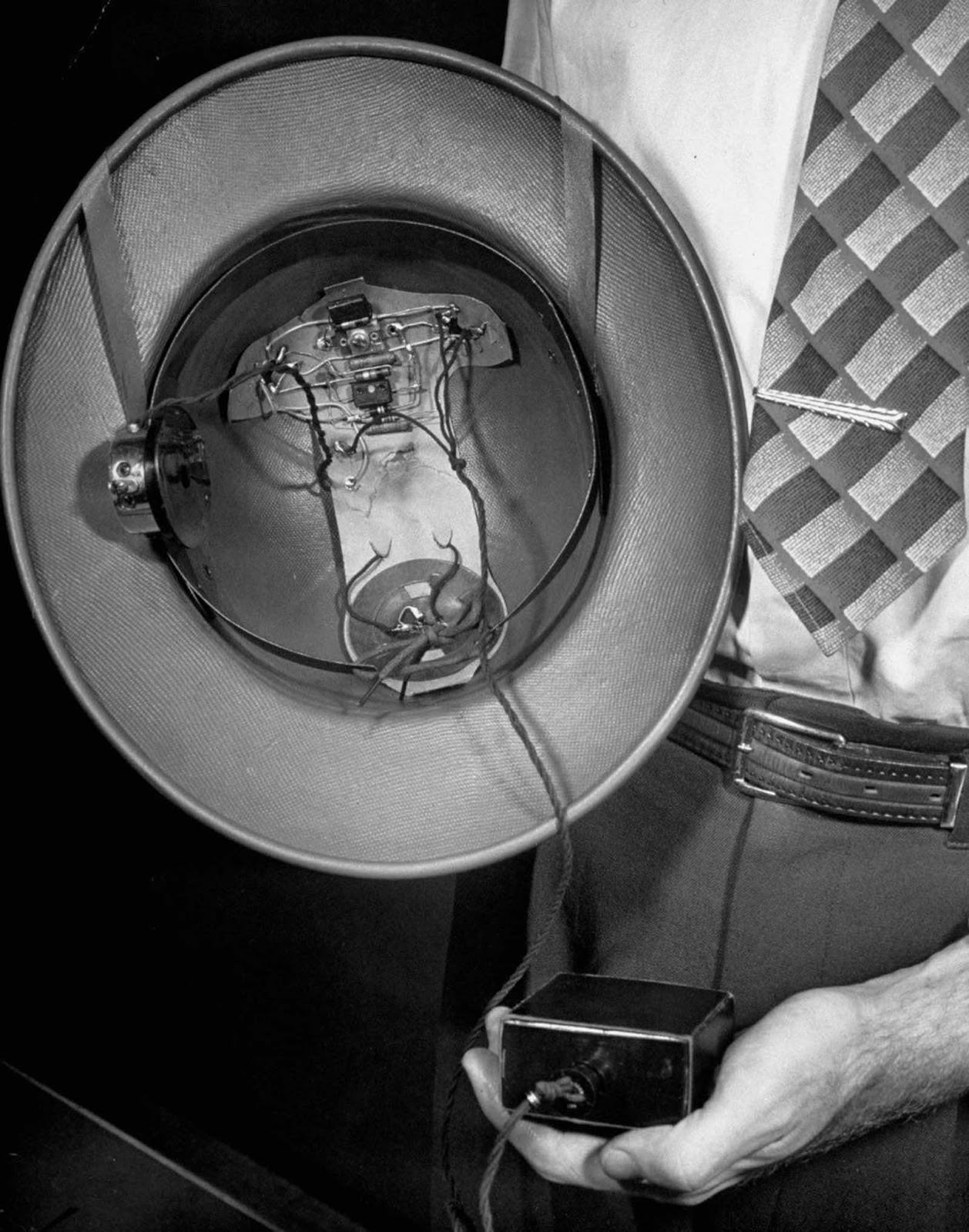
A wide-brimmed hat doubles as a piece of electronics in this striking invention-era scene, its crown opened up to reveal wiring, small components, and a compact speaker-like assembly tucked inside. The wearer’s patterned tie and neatly pressed shirt frame the contraption like a showroom pitch, while a cord trails down to a small box held in one hand—suggesting the battery pack or controls that made portable listening possible away from the wall socket. It’s equal parts clever gadget and attention-grabbing spectacle, designed to make people stop, stare, and ask how it works.
Portable, battery-operated radios were already familiar to consumers, but the race was always on to make them lighter, handier, and more desirable. Here, “innovative packaging” is taken literally: the radio is disguised as everyday clothing, turning personal style into a marketing platform and the listener into a walking billboard. The photo hints at the tinkerer’s mindset behind mid-century consumer electronics—improvisation, miniaturization, and the belief that novelty could unlock a new market.
Hoeflich’s hope for a runaway success rests in that blend of engineering and publicity, where a product’s story could travel faster than its signal. For historians of inventions and vintage technology, the image captures a moment when radio wasn’t just a device on a shelf; it was an experience to be performed, demonstrated, and sold with flair. Whether or not this particular concept caught on, it speaks to the era’s hunger for portable sound—and the imaginative lengths innovators took to stand out.