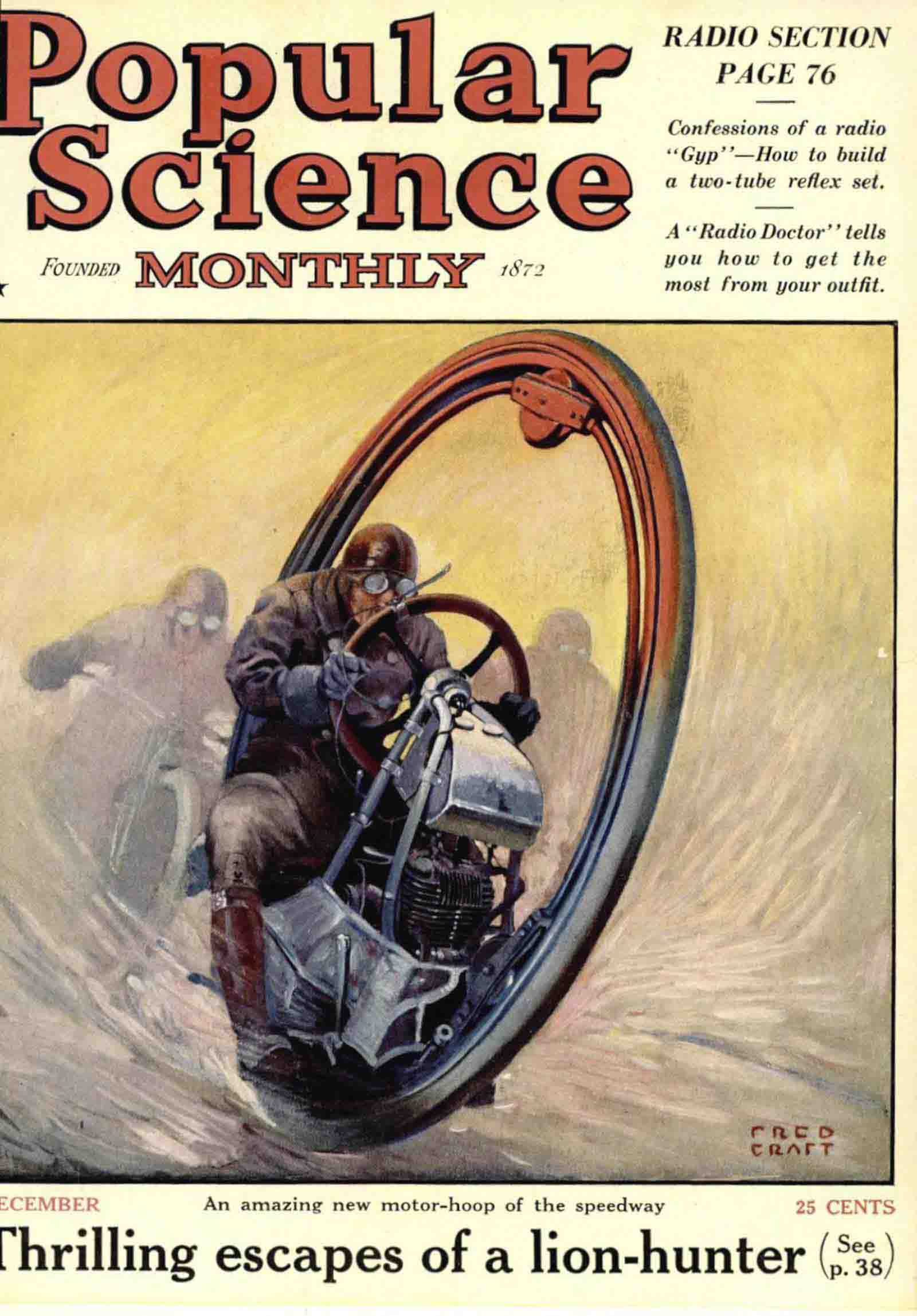
Popular Science Monthly once promised readers “an amazing new motor-hoop of the speedway,” and the cover art delivers a dream of motion: a rider tucked inside a towering single wheel, gripping handlebars as the whole machine becomes both vehicle and track. The monowheel’s circular frame dominates the composition, with streaked background lines suggesting speed and a hint of danger. Even without technical diagrams, the illustration sells the idea of radical efficiency—one wheel, one engine, and a pilot balancing inside the spinning rim.
Bizarre vehicle inventions like the monowheel sit at the intersection of engineering ambition and public fascination, and this magazine cover is a perfect artifact of that era’s optimism. The rider’s heavy gear and goggles evoke a time when speed demanded protection and courage, while the exposed machinery invites the eye to imagine how power transfers into forward motion. As a historical photo substitute in spirit—an editorial image meant to look plausible—it captures the culture of experimentation that surrounded early motorized transport.
Readers searching for monowheel facts will find that the concept has resurfaced repeatedly because it looks so simple on paper and so complex in practice. Steering, braking, stability, and the risk of the rider being carried by the wheel’s rotation all turn the “motor-hoop” into a case study in why many striking designs never become everyday vehicles. This post gathers historical visuals like this one to show how inventors and publishers sold the future—sometimes with a bold single wheel and a lot of imagination.