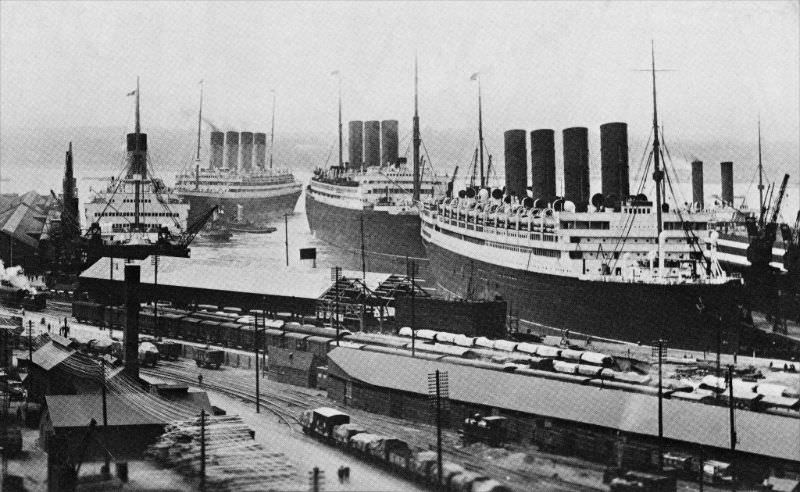
Crowding the docks at Southampton, Aquitania sits in the foreground with her long hull pressed close to the busy wharf, a wall of dark funnels rising above the harbour clutter. Along the waterfront, cranes, sheds, and a tangle of rail lines frame the scene, reminding modern viewers how closely ocean travel once depended on freight handling and the rhythms of port industry. The calm water and hazy sky soften the hard geometry of ships and infrastructure, lending the moment a sense of scale and anticipation.
August 1920 marked Aquitania’s return to commercial service, and the photograph reads like a roll call of the great Atlantic liners in waiting. Behind her, Majestic, Olympic, and Berengaria line up from left to right, their profiles stacked across the basin so that funnels and superstructures overlap like a skyline of steel. Seen together, these famous passenger ships evoke the fierce competition of the transatlantic route and the renewed push toward peacetime travel and migration after wartime disruption.
Details in the lower foreground—boxy railcars, warehouse roofs, and the straight run of tracks—anchor this maritime spectacle in the everyday mechanics that made it possible. Southampton appears not as a romantic postcard harbour, but as a working gateway where coal, baggage, mail, and provisions flowed steadily into the holds and up gangways. For readers interested in ocean liner history, maritime photography, and the early 20th-century shipping industry, this view offers a richly layered snapshot of an era when the port and the passenger ship were inseparable parts of the same machine.