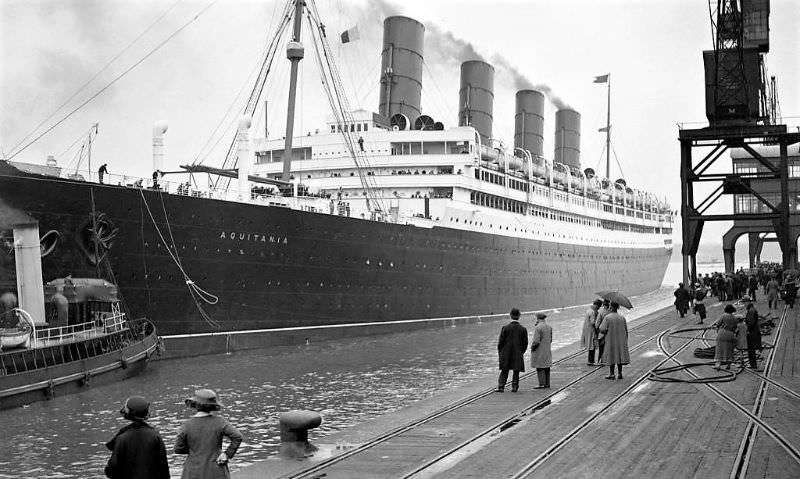
Towering over the quay, the Cunard liner Aquitania eases away from Southampton bound for New York on September 3, 1923, her great hull and stepped decks filling the frame. Four tall funnels send smoke trailing across the sky, while a small craft clings to the ship’s side and dockside cranes and rigging bracket the scene. Along the waterfront, bundled spectators pause to watch the departure, a quiet human counterpoint to the scale and power of transatlantic travel.
After World War I, Southampton emerged as Britain’s premier “big ship” terminal, a shift that reshaped the rhythms of ocean liner traffic and the fortunes of port cities. The deep-water facilities and rail links made it well suited to handle the era’s massive passenger ships, their mail, baggage, and cargo moving through an increasingly streamlined system. Images like this help explain why the port became synonymous with ocean-going departures in the early 20th century, as liners turned the Channel coast into a gateway to the Atlantic.
Details on the dock—mooring lines, wet stonework, and the neat ranks of portholes—invite a closer look at the technology and choreography behind every sailing. Aquitania’s presence suggests not just a single voyage, but a broader story of postwar travel, immigration routes, tourism, and the prestige competition among transatlantic liners. For readers interested in Cunard history, Southampton docks, and the golden age of ocean liner departures, this photograph offers a vivid, grounded glimpse of maritime life between the wars.