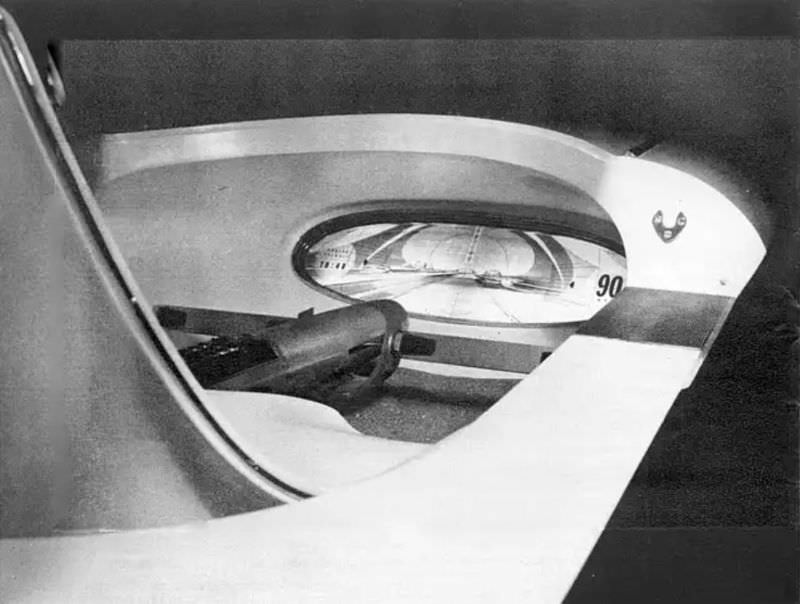
Peering through the Gyron’s canopy is like looking into a mid-century idea of tomorrow: a streamlined cockpit tucked inside a smooth, sculpted body that feels closer to an aircraft fuselage than a conventional car. The oval window and sweeping curves emphasize how radically the 1961 Ford Gyron departed from the four-wheeled norm, promising stability on just two wheels through gyroscopic balance. Even in this tight view, the design reads as an experiment in speed, efficiency, and futuristic styling—exactly the kind of concept that made automakers’ research labs famous.
Inside, the controls appear compact and purposeful, suggesting a vehicle meant to be piloted rather than merely driven. The broad, uncluttered surfaces and the forward-focused seating position echo the era’s fascination with jets, rockets, and the space age, translating those influences into an automotive prototype. Details like the pronounced canopy rim and the sense of enclosure hint at a protective capsule, reinforcing the Gyron’s identity as a gyrocar concept built to challenge assumptions about how a road vehicle could be shaped and stabilized.
Ford’s Gyron is often remembered less as a product and more as a research and marketing invention—a rolling conversation piece designed to test engineering possibilities and capture public imagination. Concept vehicles like this helped define the language of future mobility, even when they never reached everyday streets. For readers interested in automotive history, experimental transportation, and 1960s concept cars, this photo offers a rare look at the bold interior view of a two-wheeled gyro-stabilized dream.