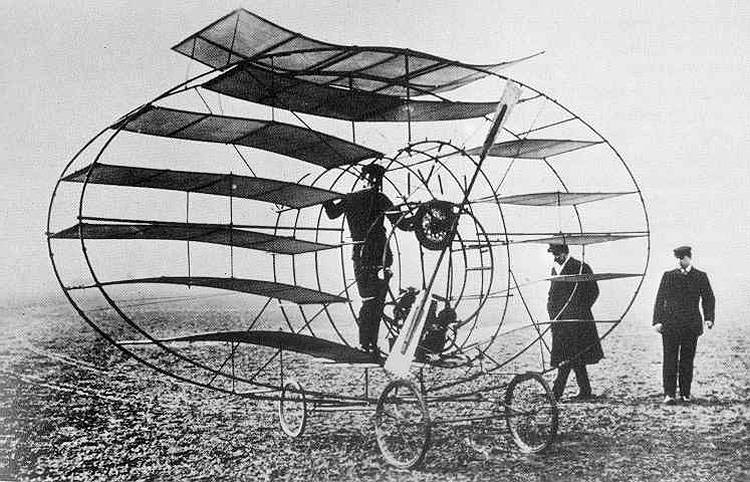
A skeletal flying machine dominates the frame, its ribbed oval structure wrapped in bands of fabric like a giant lantern laid on its side. At the center, a pilot stands poised among spoked wheels, struts, and a bicycle-like undercarriage, while a small boxy control surface rises above like a tentative canopy. Two onlookers in dark coats and hats keep their distance on the right, their posture suggesting equal parts curiosity and caution as they size up a contraption that seems half engineering experiment, half dare.
D’Equevillay 1908 fits neatly into the restless age of invention, when aviation was still being argued into existence one risky trial at a time. The design here hints at a search for stability through an enclosing frame, a bold departure from the cleaner wing shapes that would later define early aircraft. Details such as the exposed gearing, the lightweight wheel set, and the open framework speak to a workshop mentality—build quickly, test outdoors, adjust, and try again.
For readers interested in early aviation history and turn-of-the-century inventions, this photograph offers a vivid snapshot of ambition before standardization. The barren ground and overcast sky keep the focus on the machine’s geometry and the human scale beside it, underscoring how experimental flight once looked more like bicycle mechanics than modern aeronautics. Whether or not this particular attempt ever lifted cleanly into the air, it preserves the spirit of 1908: confidence in ingenuity, and a willingness to learn in public from every prototype.