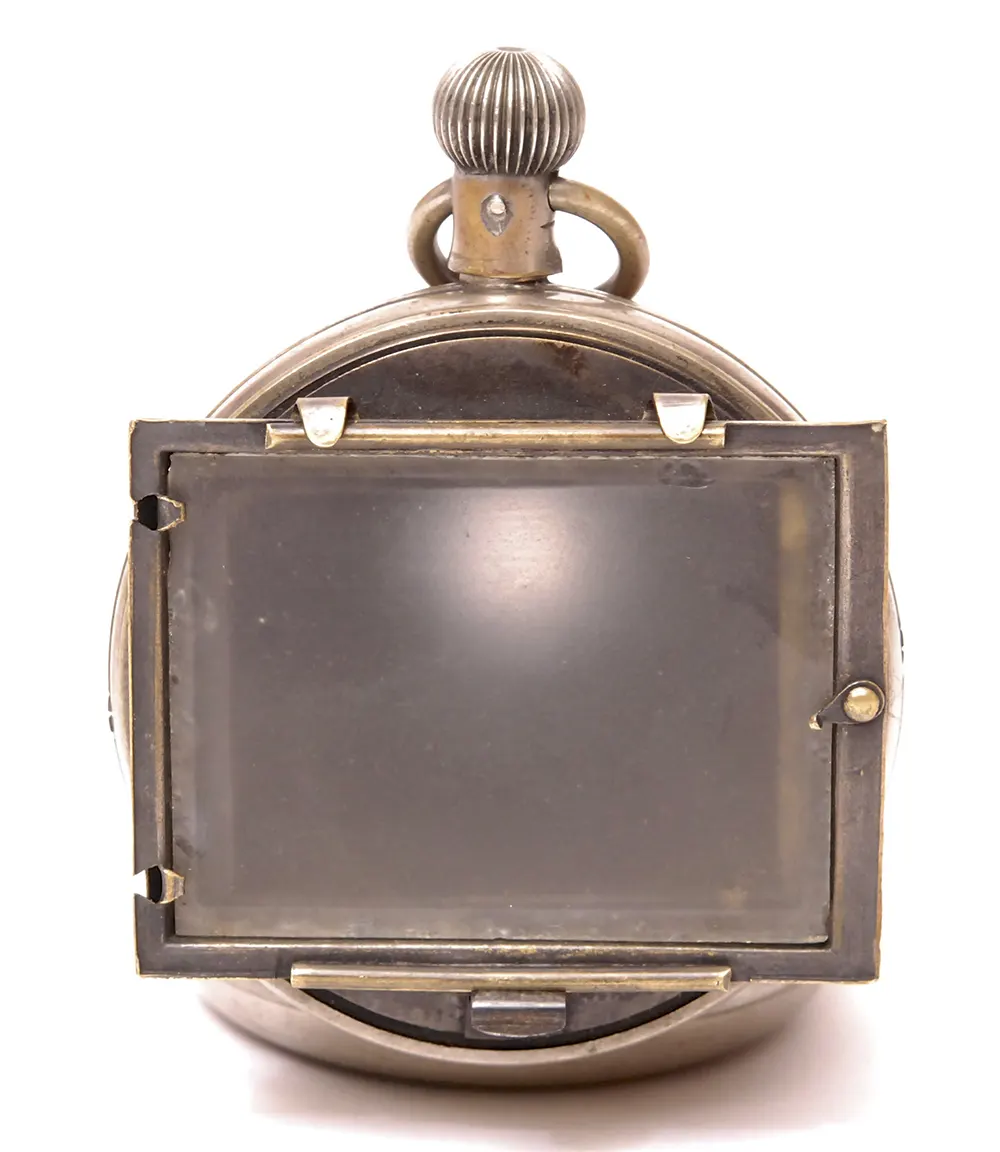
Brass curves and a familiar watch-shaped silhouette make this Lancaster Watch Camera feel instantly recognizable, until the hinged plate and dark viewing surface give away its second life. What looks like an ordinary pocket timepiece becomes, on closer inspection, a compact photographic apparatus—an object designed to vanish in plain sight while still delivering a usable image. The polished metal, crown-like top, and sturdy fittings speak to Victorian confidence in precision engineering and well-made personal gadgets.
In the late 19th century, photography was shrinking, speeding up, and slipping away from studio formality, and devices like this turned the act of taking a picture into something mobile and opportunistic. The charm—and the unease—of a “spy” camera isn’t only in secrecy, but in how it reframed everyday public spaces as potential subjects. A tool that could be carried like a watch hinted at new possibilities for candid street scenes, private moments, and the emerging culture of snapshots.
Collectors and history enthusiasts are drawn to this 1893 invention because it sits at the crossroads of horology, early camera design, and the Victorian appetite for clever concealment. The photograph here highlights the camera’s back and hardware details, inviting viewers to imagine the careful loading, the discreet handling, and the small mechanical actions that once led to a developed exposure. As a piece of antique photography technology, the Lancaster Watch Camera remains a pocket-sized reminder that innovation has long been as much about portability and surprise as it is about optics.