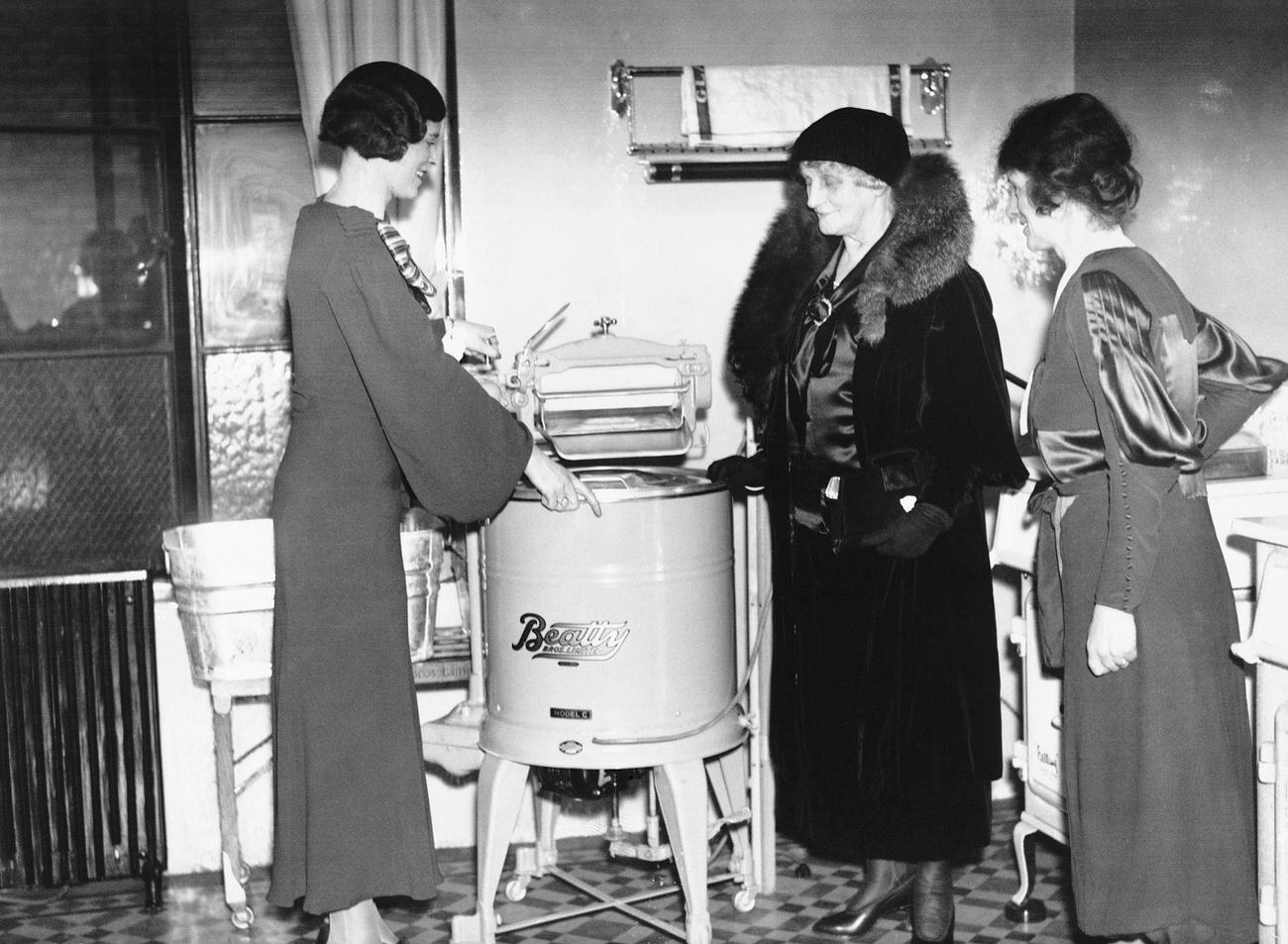
Lady Moir and Miss Minoprio stand in a neatly arranged demonstration room, turning their attention to a stout, drum-shaped appliance set on splayed legs and small wheels. The machine’s lid is raised to reveal a pair of rollers—the mangle—positioned to press water from freshly washed fabrics before they are hung or ironed. Around them, the practical surroundings of a laundry or showroom are suggested by a metal tub, a radiator, and the clean lines of nearby fittings, all reinforcing that this is a moment devoted to modern domestic engineering rather than mere social display.
What makes the scene so compelling is the contrast between elegance and utility: fashionable coats, gloves, and carefully styled hair beside an invention designed for repetitive, wet work. The combined washing machine and mangle represents a push toward efficiency, promising to reduce the heavy lifting, wringing, and time that laundry once demanded. Even without a visible maker’s story or a specific setting named, the photograph speaks to a period when household technology was increasingly marketed as a mark of progress and comfort.
In a WordPress post about inventions, this historical photo offers rich detail for anyone researching early home appliances, laundry history, or the evolution of labor-saving devices. It hints at the public rituals of innovation—inspection, demonstration, approval—through which new machines gained trust and attention. Look closely at the rollers, the open top, and the machine’s sturdy frame, and you can almost hear the sales pitch: cleaner clothes, quicker drying, and a domestic routine reshaped by mechanization.