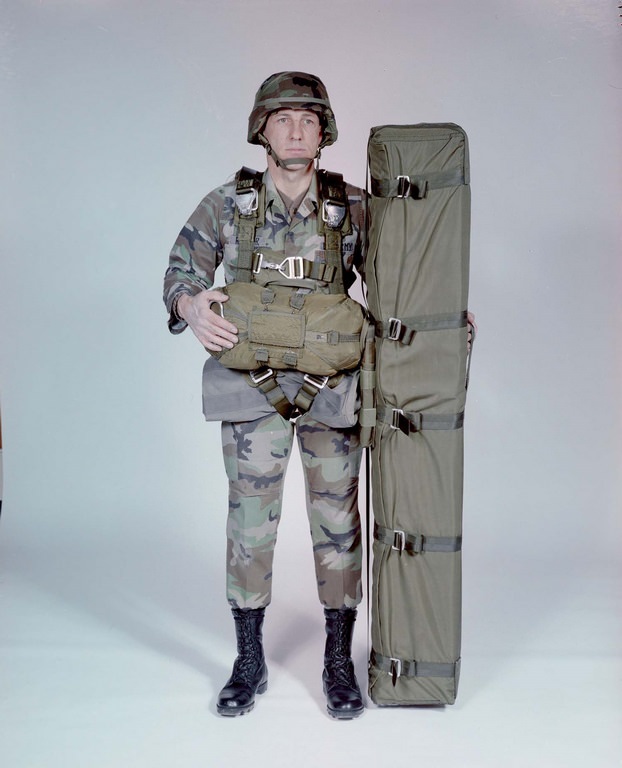
A uniformed soldier stands squarely against a plain backdrop, wearing a helmet and a bulky harness system that reads as equal parts parachute rig and experimental load-bearing gear. The straps, buckles, and reinforced webbing dominate the frame, drawing attention to how much engineering goes into simply keeping a person and their equipment secure. Beside him, a tall, rectangular soft case with multiple compression straps hints at the specialized hardware this setup was meant to carry.
The title—“ADEL (AMEL), stinger missile jump pack”—pushes the viewer beyond ordinary field kit and into the realm of inventive military logistics. Pairing an infantry-portable missile system with a “jump pack” concept suggests a solution aimed at rapid deployment, where anti-air capability could be moved quickly by airborne troops rather than waiting on vehicles or heavier support. Even without technical schematics, the photograph conveys the practical problem being tackled: how to package an awkward, high-value system so it can be transported, protected, and made ready under pressure.
As a piece of invention history, the scene is almost clinical in its clarity, letting the gear speak through form and function rather than drama. The soldier’s steady posture emphasizes scale—human proportions as the measuring stick for the equipment’s size, weight distribution, and usability. For readers interested in Cold War-era military technology, prototype equipment, and the evolution of portable air-defense deployment, this image offers a grounded, revealing look at the marriage of mobility and firepower.