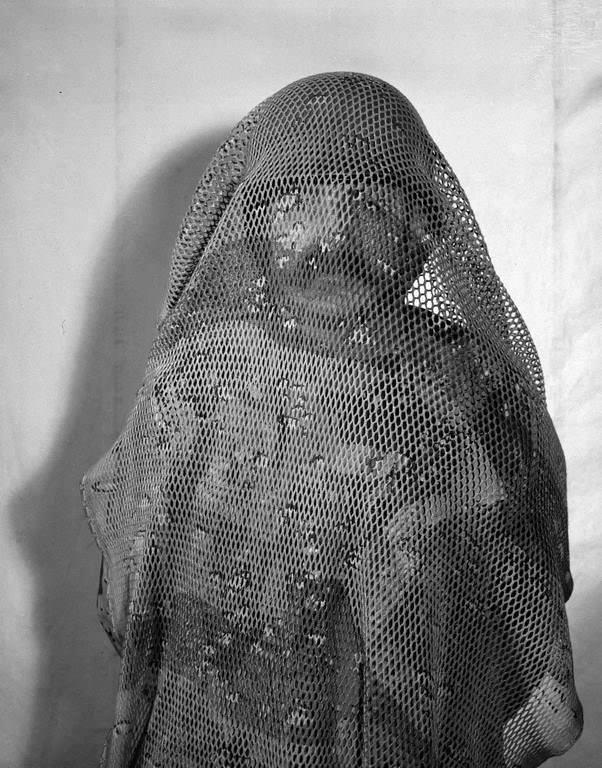
Mesh netting drapes over a helmeted head and shoulders, turning a familiar military silhouette into something softer and harder to read at a glance. Through the open weave, a patterned uniform still shows, but the texture breaks up clean edges—exactly the kind of small visual trick that matters in open, bright terrain. The stark backdrop and close framing keep attention on the material itself, emphasizing function over drama.
Desert camouflage in 1973 wasn’t only about color; it was also about controlling contrast, shine, and outline in harsh light. Netting like this could reduce glare and add depth, while also offering a base for attaching bits of fabric or natural material when needed. As an “invention,” it speaks to practical experimentation: lightweight, quick to deploy, and adaptable to whatever conditions a unit expected to face.
For readers interested in military history, field gear, and the evolution of camouflage, this photo highlights how improvisation and design often meet in the simplest objects. The net’s honeycomb pattern creates a kind of visual noise that can be as important as any printed pattern on cloth. Taken together with the title, it offers a compact glimpse into 1970s thinking about concealment in desert environments—where seeing and being seen could hinge on the smallest detail.