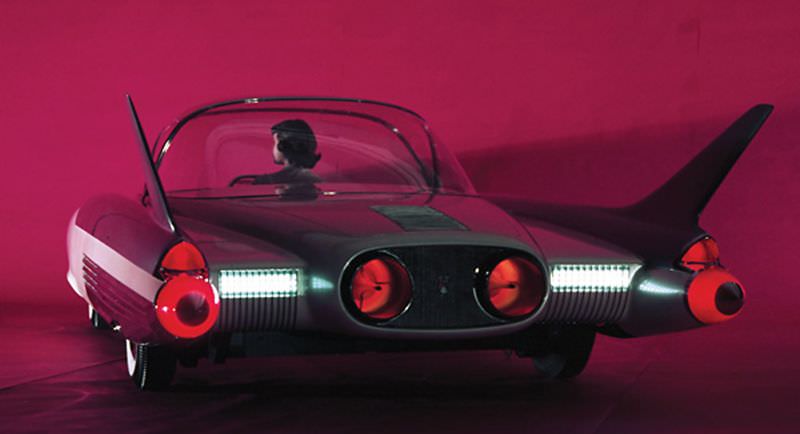
Few concepts embody mid-century optimism like the Ford FX-Atmos, a show car that looks less like a sedan and more like a small spacecraft waiting for clearance. The sweeping bodywork, dramatic tail fins, and a cockpit-like glass dome roof turn the idea of everyday driving into pure science fiction, with a poised figure under the canopy adding scale to the machine’s otherworldly silhouette. Even in a static studio setting, the design reads as motion—sleek, low, and engineered to suggest speed rather than merely deliver it.
At the rear, the FX-Atmos leans hard into the era’s fascination with jets and rockets, trading conventional taillights for “rocket exhaust” forms that resemble thrusters. Ribbed textures, bold circular elements, and illuminated accents create a layered look that feels both industrial and theatrical, the kind of styling meant to stop a crowd on an auto show floor. Details like these weren’t just decoration; they were visual promises about the future of technology, travel, and American industrial power.
As a historical photo, this image works as a compact lesson in 1950s car culture and concept design, when automakers used experimental prototypes to test ideas and shape public imagination. The FX-Atmos remains a favorite in retro-futurism and classic concept car history because it captures the moment when “tomorrow” was streamlined, chrome-bright, and wrapped in glass. For readers exploring inventions, automotive design, or the evolution of tail fins and canopy roofs, this Ford dream machine is a vivid reminder that style can be a form of prophecy.