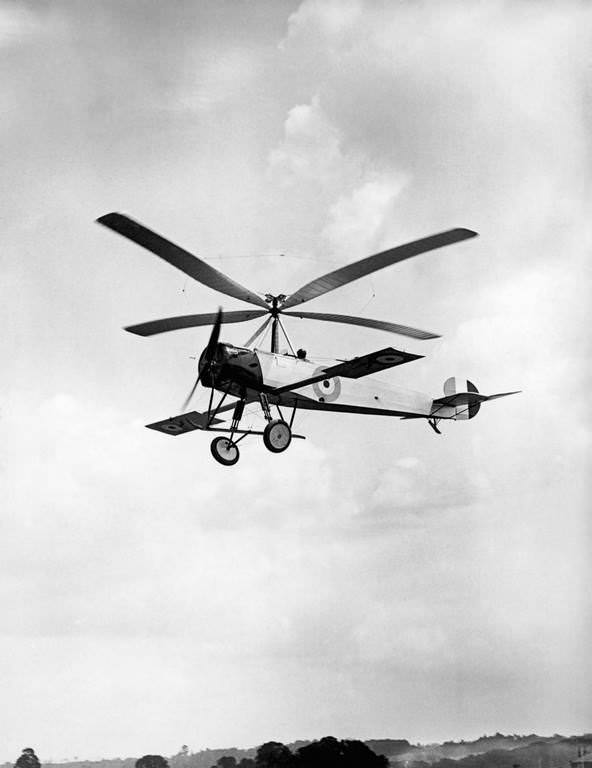
Suspended against a wide, cloud-dappled sky, a Cierva C-30 autogyro glides with its rotor disc spread like a windmill and its fixed wings carrying RAF-style roundels. The undercarriage hangs plainly beneath the fuselage, and the whole machine reads as both airplane and something entirely new—an ingenious hybrid built for experimentation. Even at a distance, the open, mechanical look of the craft evokes the hands-on inventiveness that defined early rotary-wing flight.
In 1926, British test pilots were pushing boundaries with aircraft that didn’t yet fit familiar categories, and the autogyro was among the most intriguing. Unlike a helicopter, the rotor here isn’t powering the craft straight up; it turns in the airflow while a conventional propeller provides forward thrust, allowing remarkably slow flight and short takeoffs. The photograph freezes that transitional moment in aviation history when engineers searched for safer, more flexible ways to fly, especially at low speeds and in tight spaces.
Details like the braced rotor head, the spindly struts, and the compact tailplane speak to a period when stability and control were still being learned by doing. For readers interested in inventions and early aviation, this image offers a crisp window into interwar experimentation and the stepping-stones toward modern rotorcraft. It’s not only a record of a flight test—it’s a portrait of an idea taking shape in the air.