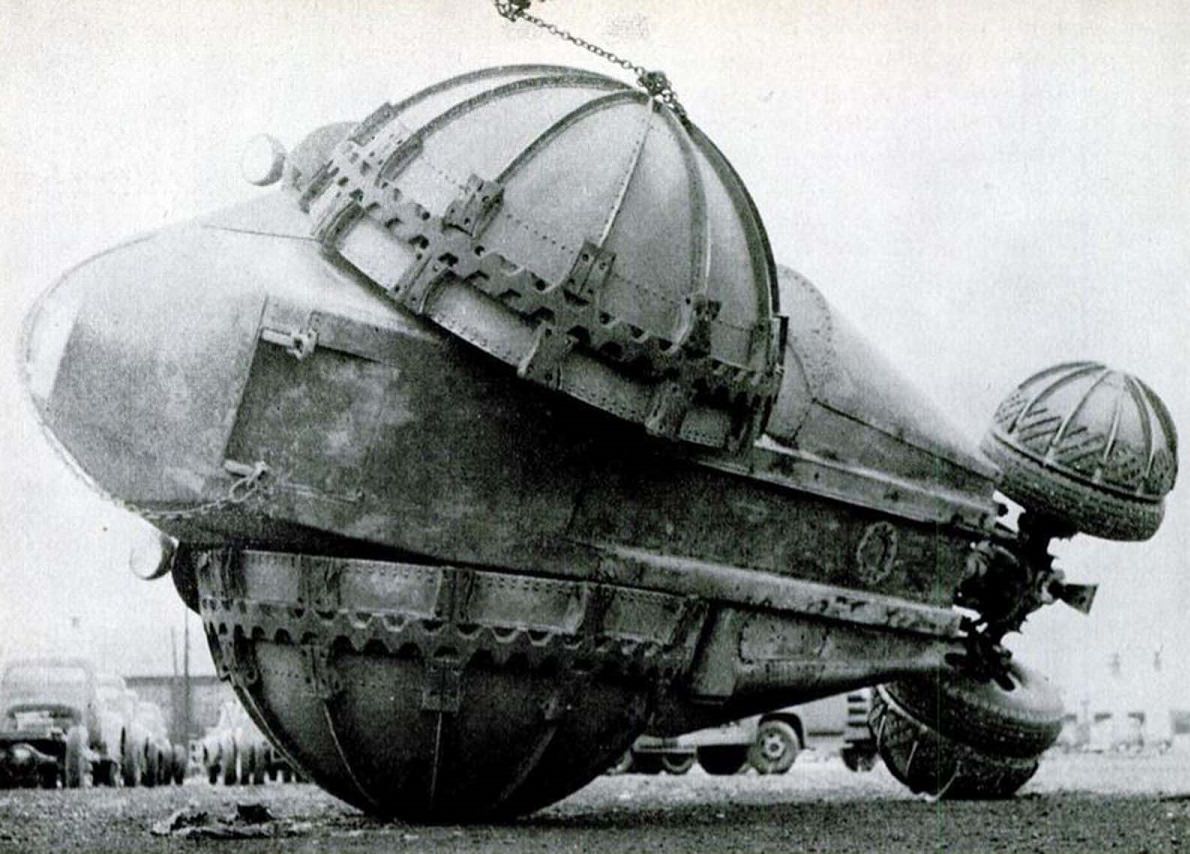
An odd, armored sphere dominates the scene, its metal ribs and riveted seams curving into a rolling hull that looks more like industrial sculpture than a vehicle. Suspended by a crane and tipped at an alarming angle, the “Rhino” appears to balance on its rounded body while onlookers gather at a safe distance, as if waiting to see whether gravity will finally win. The title’s claim—listing 74 degrees without toppling—turns the photograph into a clear demonstration of stability by design, not a lucky moment caught on film.
What stands out is how the machine’s geometry does the talking: a low center of gravity paired with a near-spherical profile that resists the easy tipping points of conventional cars or tracked platforms. The domed caps, braced bands, and heavy lower mass suggest an inventor’s solution to uneven ground, obstacles, and rollovers—problems that plagued early experiments in off-road mobility and armored transport. Even without technical captions, the visual language of test rigging, chains, and careful staging signals a prototype being pushed to its limits.
For readers interested in historical inventions, this photo offers a memorable window into the era’s faith that clever engineering could tame terrain through pure form. “Rhino” becomes a case study in stability engineering: how weight placement and shape can keep a vehicle upright even when it’s dramatically canted. It’s also a reminder that the path to practical machines is littered with bold, sometimes strange-looking experiments—each one photographed to prove a point and persuade skeptics that it might actually work.