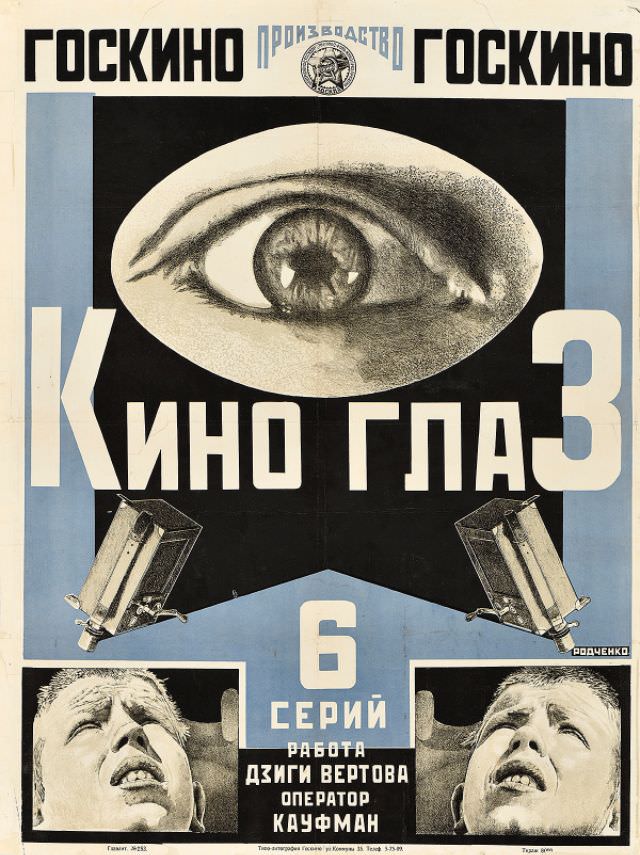
Bold Cyrillic lettering and a giant, watchful eye dominate this striking poster for *Kino-Eye* (1924), directed by Dziga Vertov. The design turns vision into a symbol of modern cinema itself—part human perception, part mechanical precision—hinting at a film determined to see the world differently. Even without reading Russian, the graphic clarity pulls you in: high contrast, sharp geometry, and a layout that feels as urgent as a news bulletin.
Across the composition, the language of filmmaking becomes the subject: cameras angle inward like instruments aimed at reality, while expressive faces at the bottom suggest raw, unvarnished human experience. The central “eye” functions as both emblem and promise, evoking the idea of the camera as an extension of sight—recording, analyzing, and revealing what ordinary viewing might miss. It’s propaganda of perception in the best sense, advertising not only a movie but a new way of understanding movies.
For collectors and film-history readers, this artwork sits at the crossroads of Soviet avant-garde poster design and early documentary experimentation, making it an essential piece of silent-era visual culture. As a WordPress feature, it’s ideal for posts on Dziga Vertov, early Soviet cinema, or the evolution of documentary aesthetics, with built-in SEO appeal around classic film posters and 1920s movie history. The poster’s message remains contemporary: cinema isn’t just entertainment—it’s a tool that trains the eye.