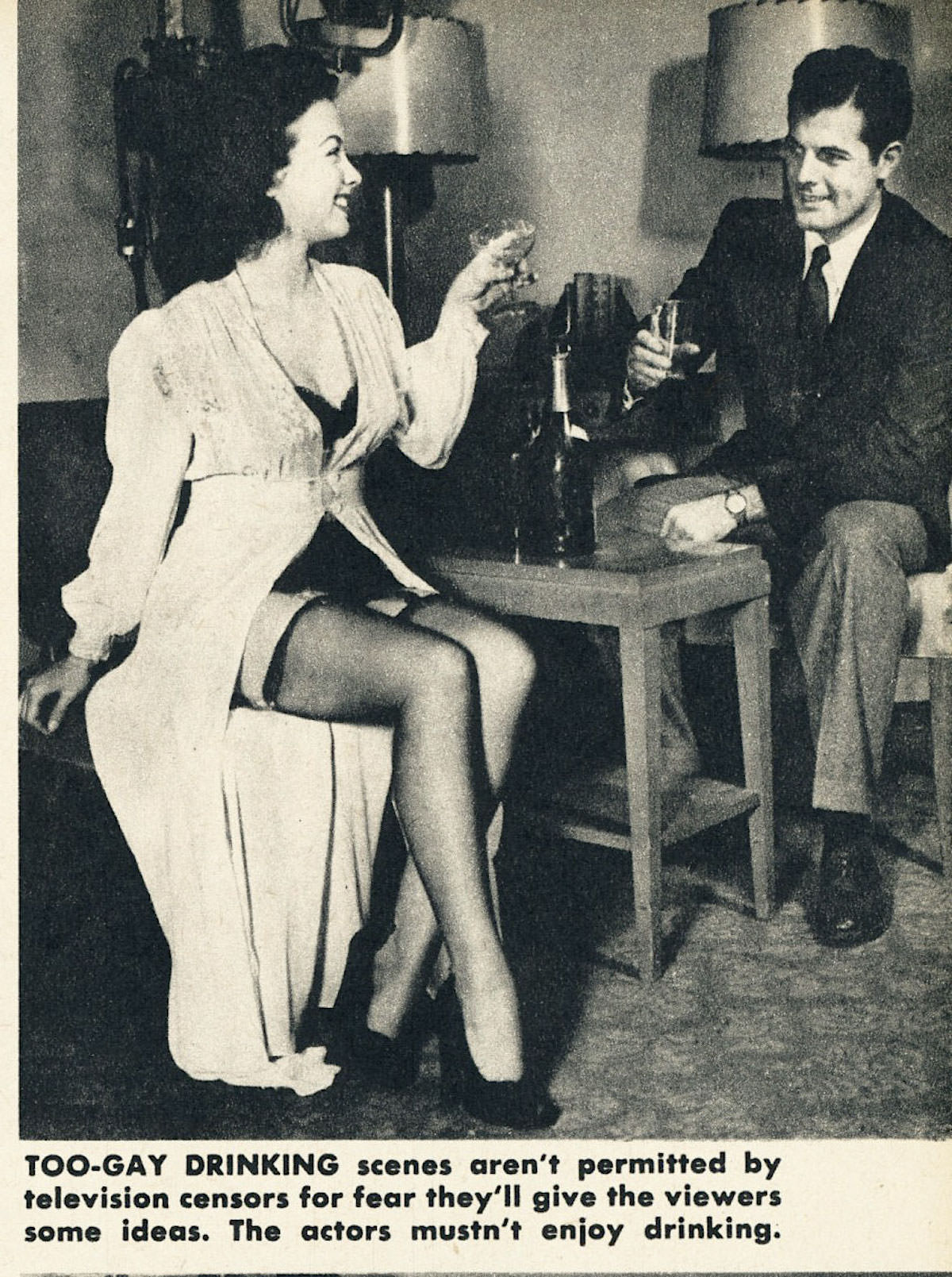
A living-room set, a small side table, and two raised glasses set the stage for a lightly charged moment that feels pulled straight from mid-century movies and early television. The woman lounges in a robe that slips open like a costume cue, while the man—suited, neat, and watchful—meets her smile across the table, bottle centered between them as if it’s part of the script. Everything about the composition suggests “on-camera” intimacy: theatrical lighting, deliberate poses, and a flirtation calibrated to read clearly even in a grainy print.
Beneath the photo, the caption’s phrase “Too-gay drinking” lands like a time capsule of censorship anxieties, when regulators worried that a scene could appear too convivial, too carefree, or too suggestive. The idea that performers “mustn’t enjoy drinking” points to a broader moral code that shaped what audiences were allowed to see—where pleasure often had to be punished, and where a raised glass could become a moral problem rather than a simple prop. It’s a reminder that entertainment history isn’t only about what was filmed, but also about what was restricted, softened, or reframed to satisfy gatekeepers.
Seen today, the image reads as both a playful publicity still and a document of control: the warm chemistry on display contrasted with the chilly logic of broadcast standards. For readers interested in classic film culture, television censors, and the history of on-screen drinking, this post offers a snapshot of how “fun” could be policed and how subtext was monitored as closely as dialogue. The tension between what the actors convey and what the caption warns against is precisely what makes this artifact so searchable, shareable, and worth revisiting.