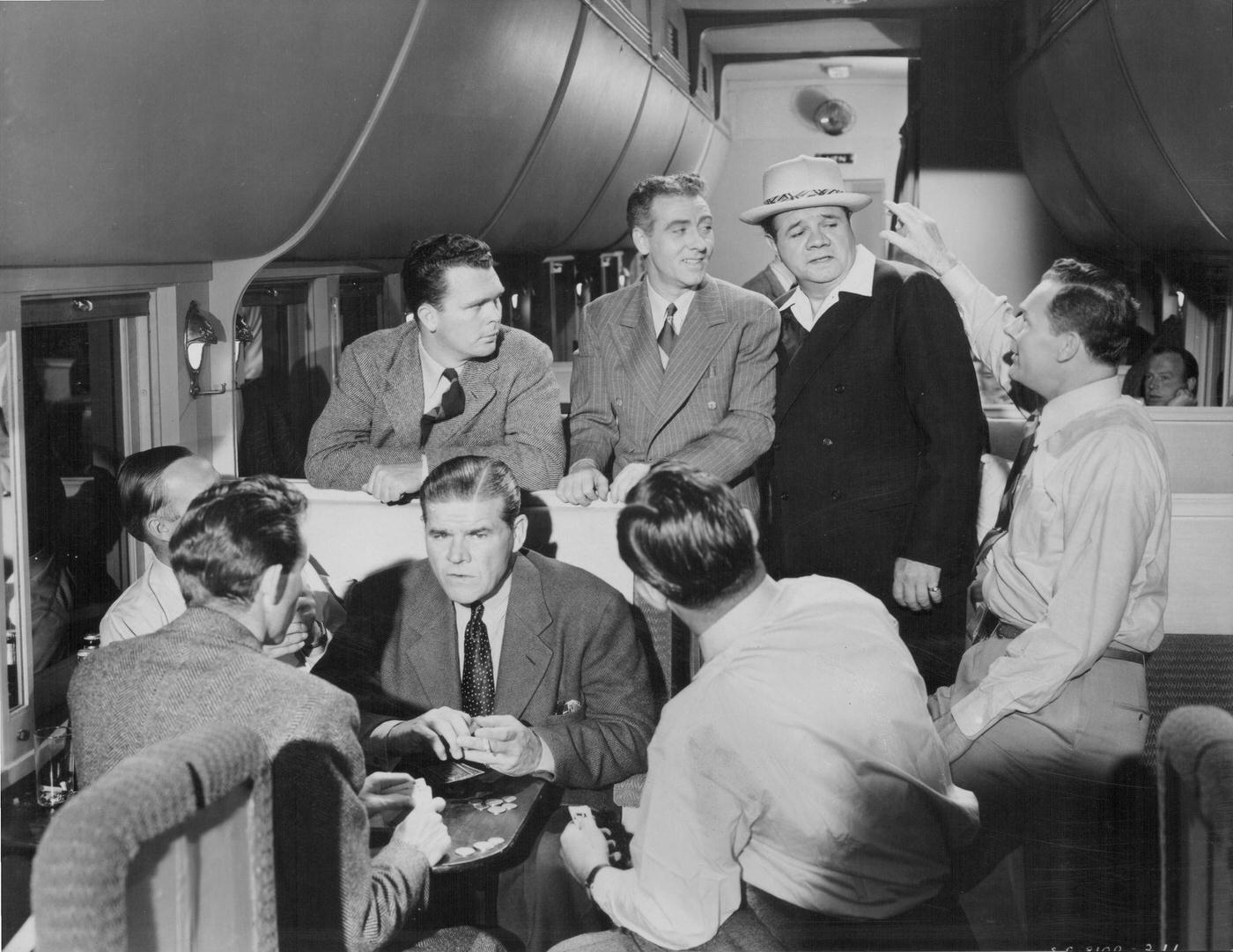
Babe Ruth appears here not in a ballpark, but in a movie set-up where the camera lingers on personality as much as fame. Dressed in a dark coat and light hat, he stands amid a tightly packed group of men in suits and shirtsleeves, the kind of everyday wartime-era look that instantly places the scene in early-1940s Hollywood. The setting resembles a train or lounge car, with curved walls, close seating, and faces turned toward an animated speaker.
Rather than spotlighting a swing or a home run, the moment leans into conversation and camaraderie—cards on the table, elbows on the seatback, and expressions that suggest a lively exchange just off script. Ruth’s presence reads as a cameo with weight: a sports legend playing himself, framed as part of a social world where celebrity can sit shoulder-to-shoulder with ordinary working men. It’s a reminder that classic baseball culture traveled beyond stadium gates and into the era’s most influential storytelling machine.
Tied to the 1942 film “The Pride of the Yankees,” the photo bridges Movies & TV with American sports history in a single, candid-feeling tableau. For fans of Golden Age cinema, it offers a behind-the-scenes flavor of studio realism—carefully staged yet convincingly lived-in. For baseball historians, it’s another piece of the Babe Ruth mythology, showing how Hollywood helped preserve and polish the legends of the diamond for audiences far from the bleachers.