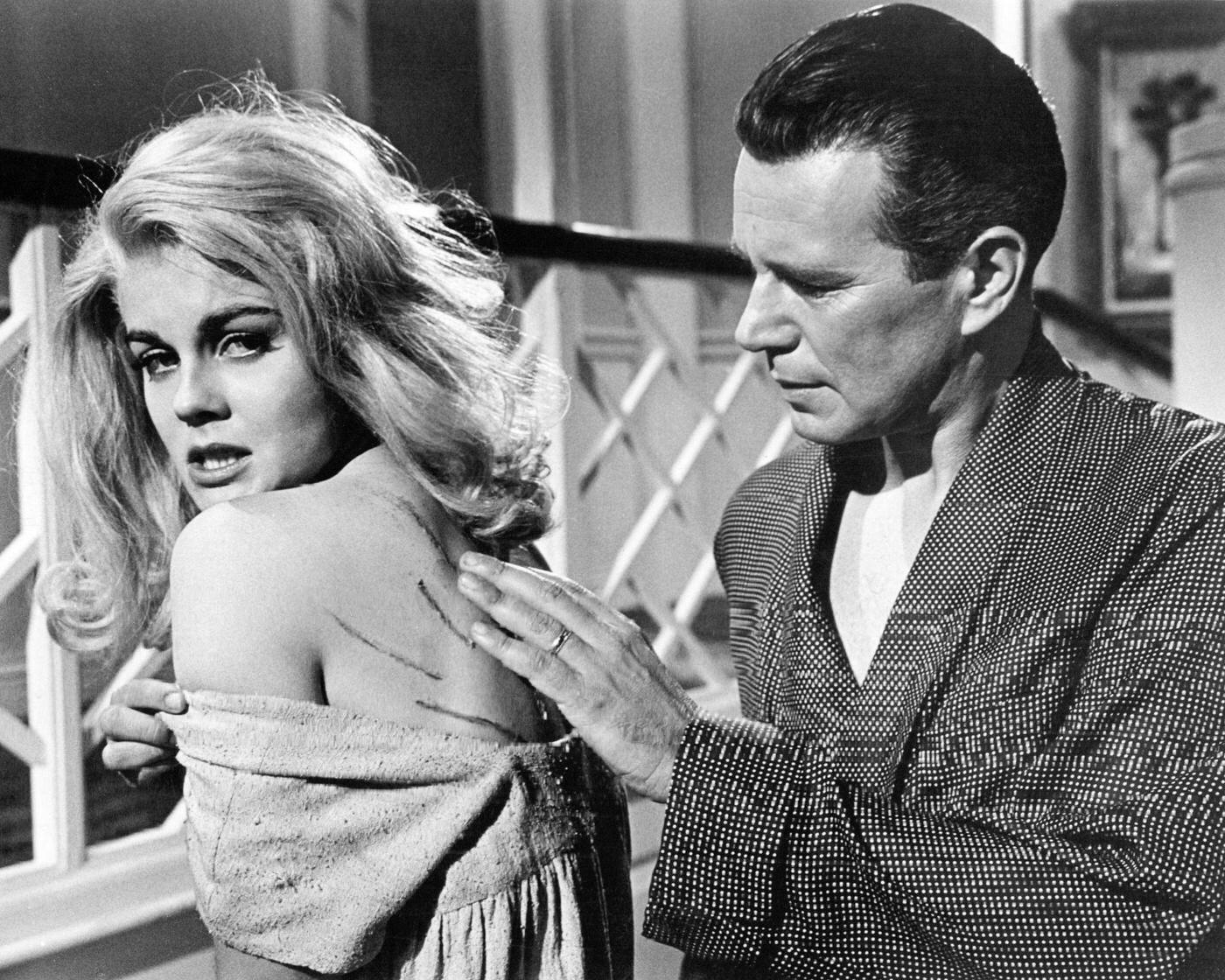
Ann-Margret, cast here as Jody Dvorak, turns her head toward the camera with a wary, half-challenging look, her hair styled in the kind of voluminous sweep that instantly signals classic Hollywood glamour. Beside her, John Forsythe as David Stratton leans in with a measured seriousness, his attention fixed on her shoulder as his hand rests lightly against her back. The composition feels deliberately intimate, balancing star power with a sense of unease that pulls the viewer into the scene.
A few sharp marks across Jody’s shoulder become the visual center of the moment, suggesting a recent struggle or a secret that won’t stay hidden. The close spacing between the characters reads as both protective and invasive, a familiar tension in mid-century Movies & TV storytelling where personal boundaries often double as plot devices. Even without dialogue, their expressions do the work: she seems caught between defiance and vulnerability, while he appears intent on understanding—or controlling—what’s happened.
Behind them, the interior setting—window framing, patterned surfaces, and a framed picture—anchors the drama in a domestic space where private conflict can flare into something cinematic. For fans searching for Ann-Margret and John Forsythe vintage stills, this image offers a compelling snapshot of character-driven suspense and screen-era style. It’s the kind of publicity photo that doesn’t just document a production; it sells a mood, hinting at the emotional stakes waiting just outside the frame.