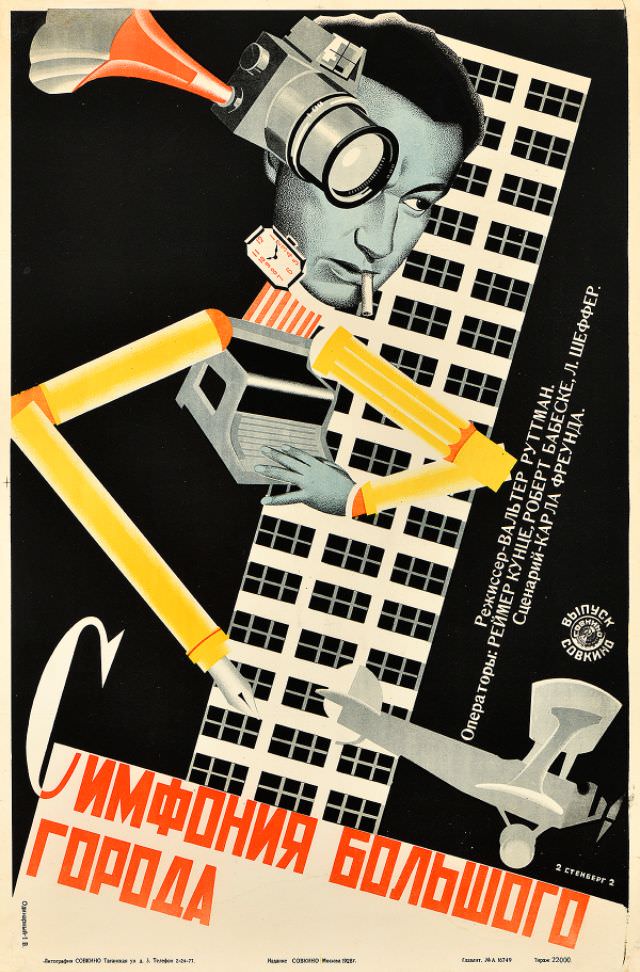
Bold geometry and a cool, mechanical elegance define this striking poster for *Berlin: Symphony of a Great City* (1927), Walter Ruttmann’s landmark city film. A stylized man, cigarette in hand, peers through an oversized camera lens while a trumpet-like horn juts forward—an eye-and-ear metaphor for cinema as modern perception. Behind him, a grid of windows rises like an urban wall, turning architecture into pattern and rhythm.
The design feels true to the Weimar-era fascination with speed, technology, and the new metropolis, where human figures and machines often blur into one another. Strong diagonals, flat color blocks, and the dramatic black ground create the sensation of movement and noise, echoing the film’s “symphony” structure built from everyday street life and industrial tempo. Even without a single frame of footage, the poster sells Berlin as a living instrument—played by labor, transit, and electric light.
Collectors and film-history readers will notice that the lettering is not in German, suggesting a foreign-language release and the wide circulation of Ruttmann’s work beyond its original audience. As a piece of silent cinema ephemera, it bridges avant-garde graphic design and early documentary montage, making it a compelling artifact for anyone researching 1920s German film, modernist posters, or the visual culture of the interwar city.