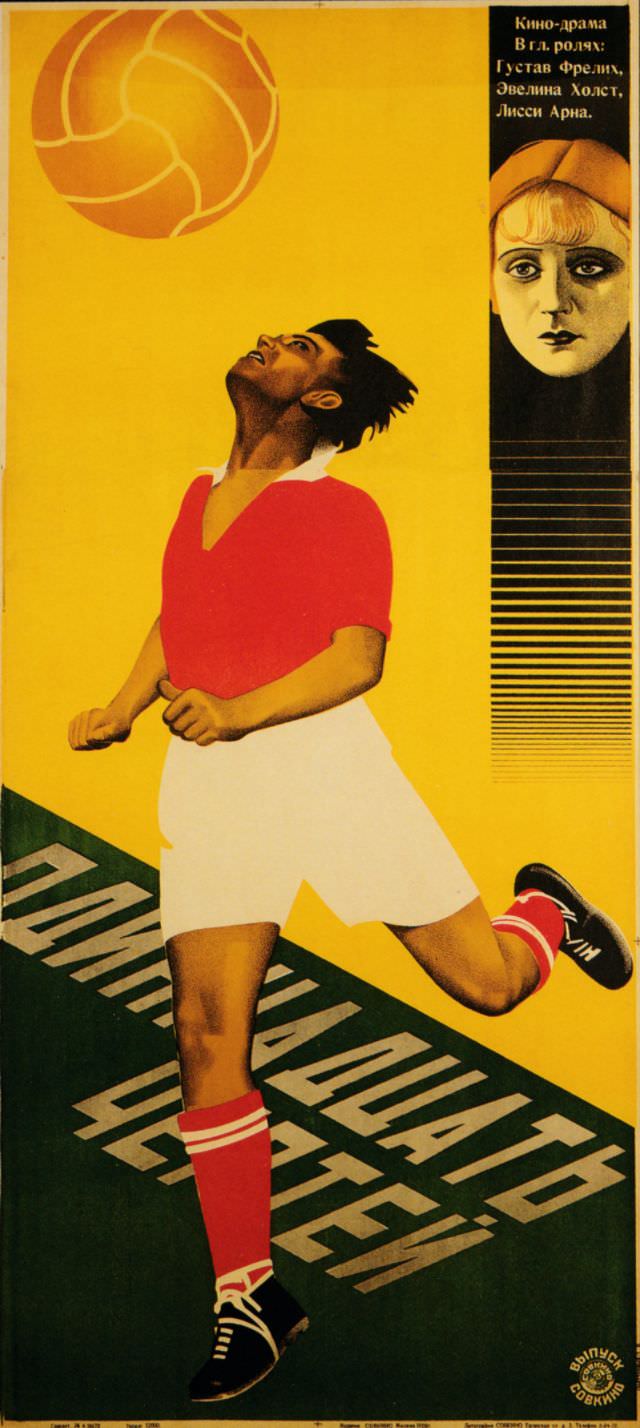
A footballer in a bright kit cranes his neck toward an oversized ball, frozen mid-stride against a bold field of yellow that feels more like modern graphic design than a 1920s cinema advertisement. The dramatic foreshortening, the punchy reds and greens, and the sharp diagonal typography all work to suggest speed, rivalry, and the kinetic pull of sport—perfect bait for audiences drawn to the era’s enthusiasm for football stories on screen.
Along the right edge, a stark portrait of a woman—rendered with the cool poise of silent-era stardom—adds a note of personal drama to the athletic spectacle. The vertical block of Cyrillic text signals the poster’s distribution in a Russian-reading market, while its composition hints at the film’s likely blend of locker-room intensity and off-field emotion, where fame, temptation, and loyalty can collide as forcefully as any tackle.
Released in 1927 and credited to directors Zoltan Korda and Carl Boese, The Eleven Devils stands as a striking example of how early cinema sold itself through daring design as much as through story. For collectors and film-history readers, this poster is a reminder that “Movies & TV” ephemera can be just as revealing as surviving reels—capturing the look, language, and marketing flair that helped silent and early sound-era audiences imagine the drama before the curtain even rose.