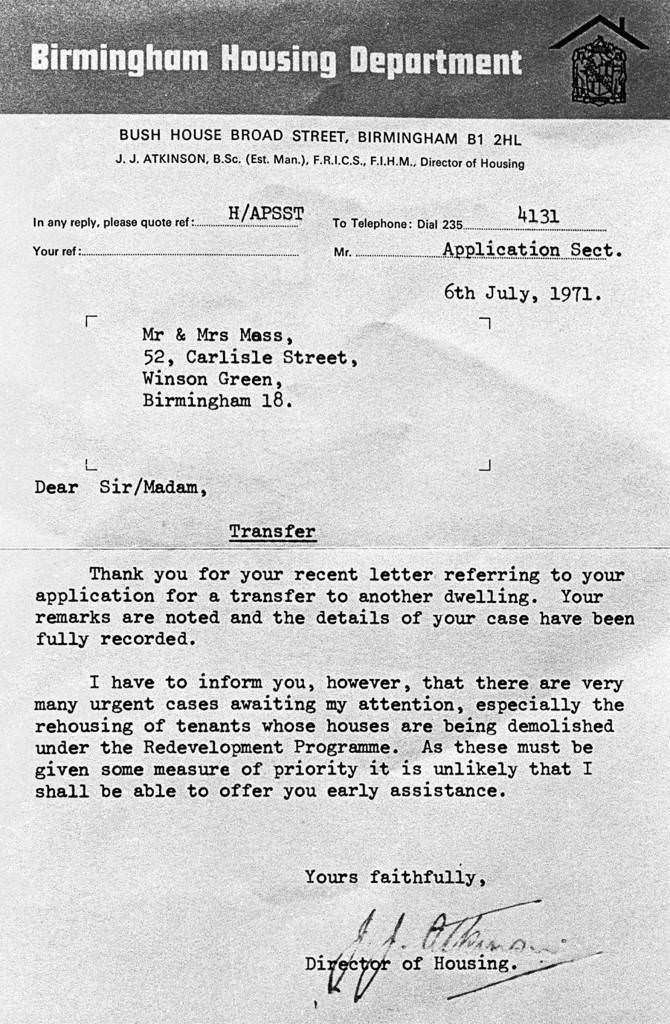
Typed on Birmingham Housing Department letterhead from Bush House on Broad Street, this 6th July 1971 document offers a stark glimpse into the everyday machinery of municipal housing. Addressed to Mr & Mrs Mass of Carlisle Street, Winson Green, it sits firmly in the world of carbon copies, reference codes, and carefully spaced paragraphs—bureaucracy made visible, with the city crest stamped at the top.
The subject is a “Transfer,” prompted by a letter that mentions health and the condition of a slum property, and the tone is polite but guarded. The reply notes the case has been recorded, yet stresses the pressure of “urgent cases,” particularly tenants being rehoused as part of a redevelopment programme, with demolitions reshaping neighbourhoods. In a few lines, the letter conveys a queue of need and the hard arithmetic of priorities that defined Birmingham’s housing landscape in the early 1970s.
For researchers of Birmingham history, social policy, and urban renewal, this is more than administrative correspondence; it is evidence of how families communicated with the council and how the council responded when demand outstripped supply. The visible addresses, departmental titles, and formal closing capture the official voice of the period, while the mention of health hints at the private struggles behind public paperwork. As a historical photo, it anchors “Places & People” in the texture of real civic life—one application, one household, and one city in transition.