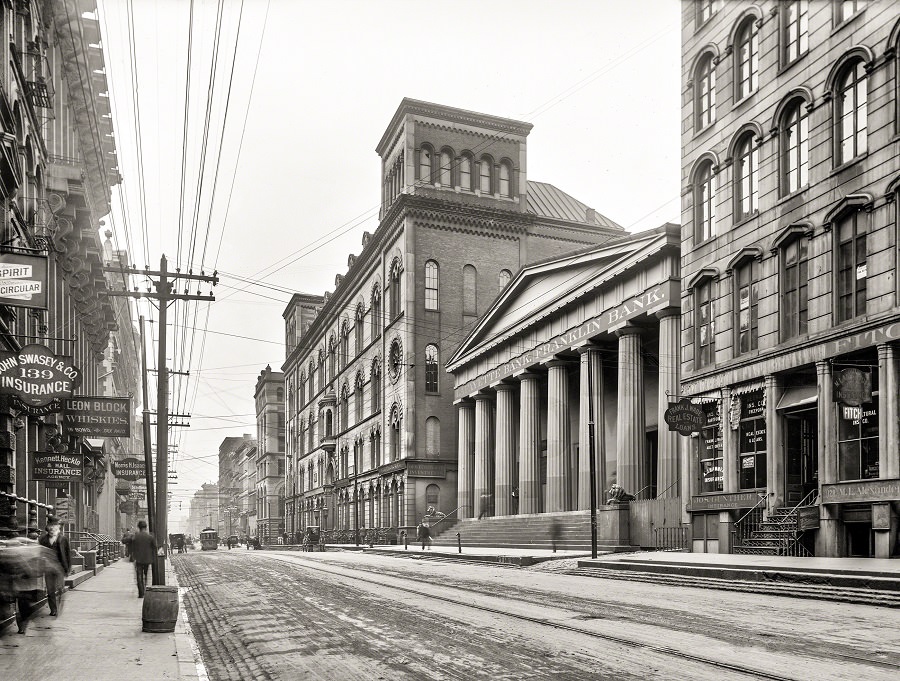
Third Street in Cincinnati stretches away in a straight, busy corridor of stone and brick, its surface worn by traffic and marked by rail grooves that hint at streetcars nearby. Overhead, a web of utility lines and poles frames the sky, while pedestrians keep to the sidewalks beneath tightly packed commercial facades. The scene reads like a cross-section of a growing American city around the turn of the twentieth century—ordered, industrious, and built for movement.
On the right, the Lafayette and Franklin Banks announce themselves with a classical temple-front entrance, its tall columns and broad steps projecting stability and confidence. Across the street rises the hefty mass of the Masonic Temple, its arched windows and layered masonry conveying permanence in a different register—civic pride and fraternal presence as much as commerce. Together, these landmarks make the block feel like a financial and institutional heart, where architecture served as public persuasion.
Details along the storefronts—insurance signage, office windows, and tightly lettered placards—pull the viewer down to street level and everyday transactions. The distant vehicles and small figures emphasize scale, reminding us how imposing these buildings were to anyone walking Third Street at the time. For readers exploring Cincinnati history, historic downtown architecture, and the city’s banking and fraternal landscape, this circa-1900 view offers a richly textured snapshot of how the urban streetscape once looked and functioned.