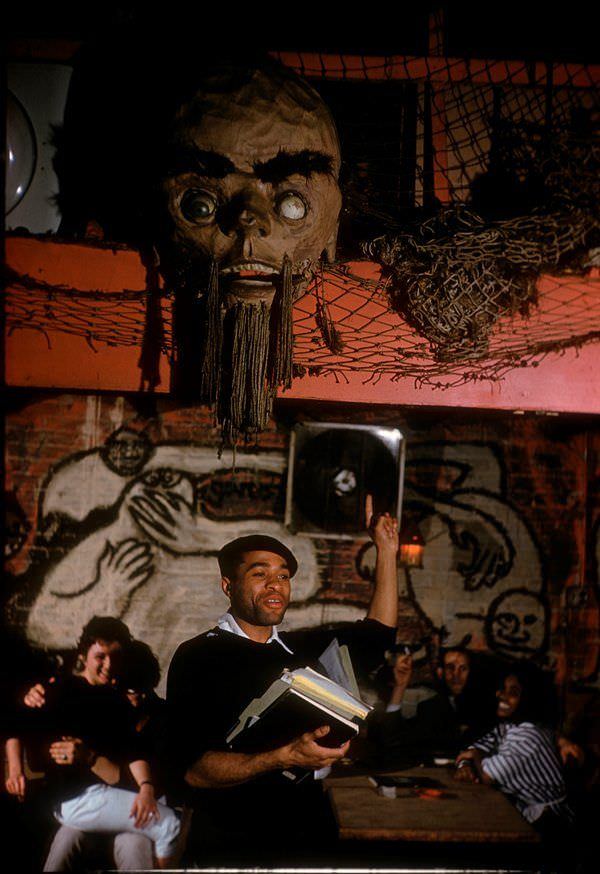
Under a looming, mask-like decoration and a tangle of netting, Ted Joans holds the room with one arm raised and a stack of pages and books tucked against his chest. The Bizarre coffee shop feels less like a café than a small stage built from found objects and bold wall art, the kind of bohemian interior where a poem could land like a drumbeat. Faces in the background lean in from the shadows, suggesting a crowd gathered close enough to catch every word.
Energy radiates from the performer’s stance: part lecture, part improvisation, part call-and-response with whoever is listening. The audience appears relaxed but attentive, clustered on benches and around a worn table, as if this reading is both a social ritual and a late-night experiment. Details like the speaker, the mural-like drawing, and the intimate seating reinforce how mid-century coffeehouse culture turned everyday rooms into hubs for poetry and performance.
Framed by the title’s year, 1959, this scene evokes a moment when spoken word and avant-garde sensibilities were finding new audiences in small, independent spaces. The photograph is rich for readers interested in Ted Joans, Beat-era poetry readings, and the broader history of cafés as cultural crossroads. It’s also a vivid “places and people” snapshot—an interior, a community, and a single voice cutting through the dim light to make the night memorable.