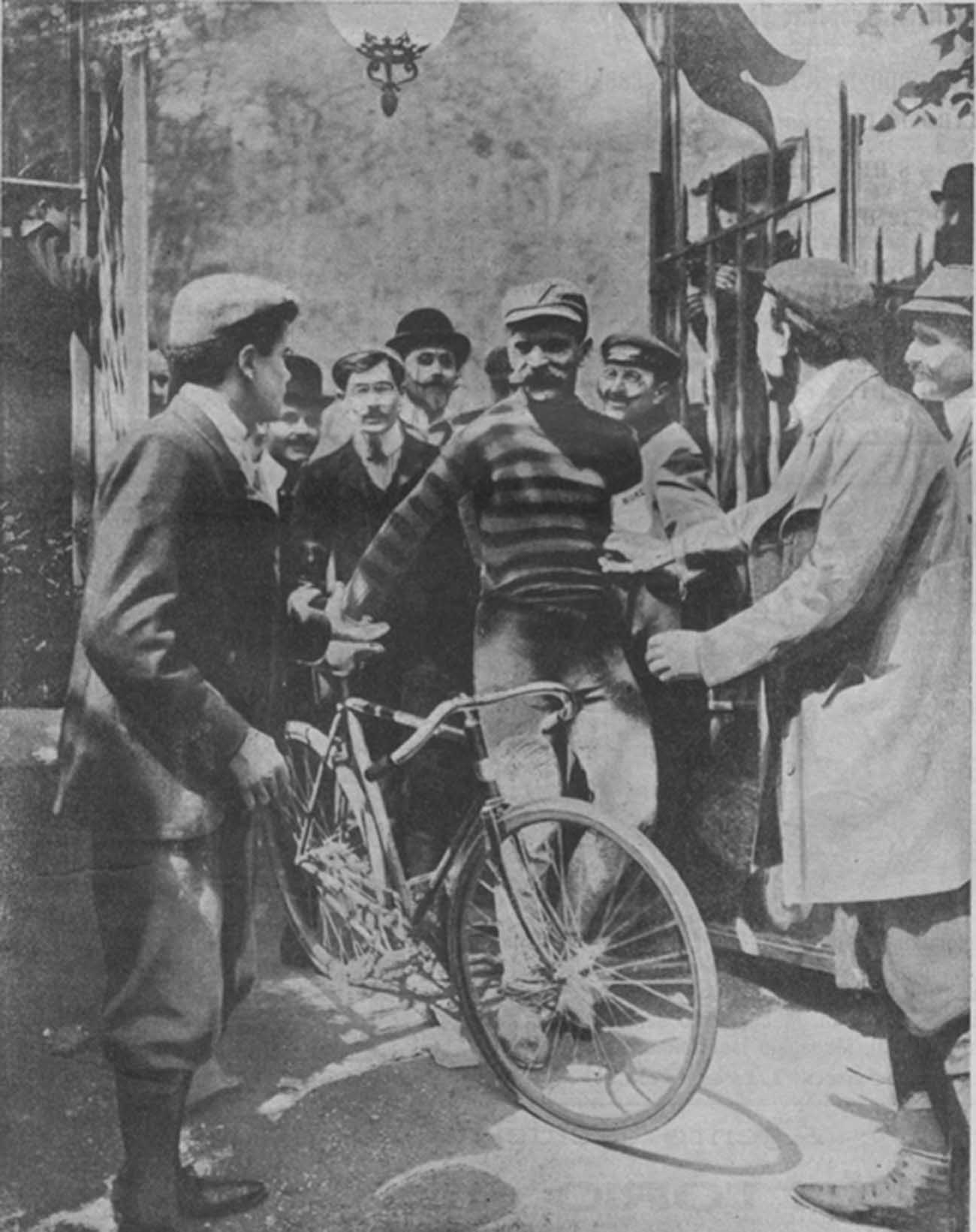
Maurice Garin pauses with one foot down and his bicycle angled toward the crowd, a striped jersey and cap marking him as the day’s hero. Faces press in close from both sides, men in flat caps and dark coats leaning forward as if to catch a word or offer a quick congratulations. The scene feels intimate and noisy even in silence, with Garin’s calm posture contrasting the eager attention surrounding him.
Around him, the details speak to the early years of competitive cycling: a lean, steel-framed machine with narrow tires, simple handlebars, and the practical clothing of riders and spectators alike. Several onlookers smile openly, while others peer from behind, framed by a fence and the flutter of flags overhead. It’s a candid glimpse of how the Tour de France era was built not only by endurance on the road, but by the public’s growing fascination with sporting champions.
For anyone searching the history of the Tour de France, images like this show how quickly a race could become a national spectacle—before television, before massive sponsorship, when admiration was delivered in handshakes and shouted praise. Garin stands at the center of a spontaneous reception, embodying the appeal of early road racing: grit, notoriety, and the thrill of proximity to greatness. As part of a 1903 Tour de France photo collection, this moment captures the human scale of cycling history and the enthusiasm that helped the sport take root.