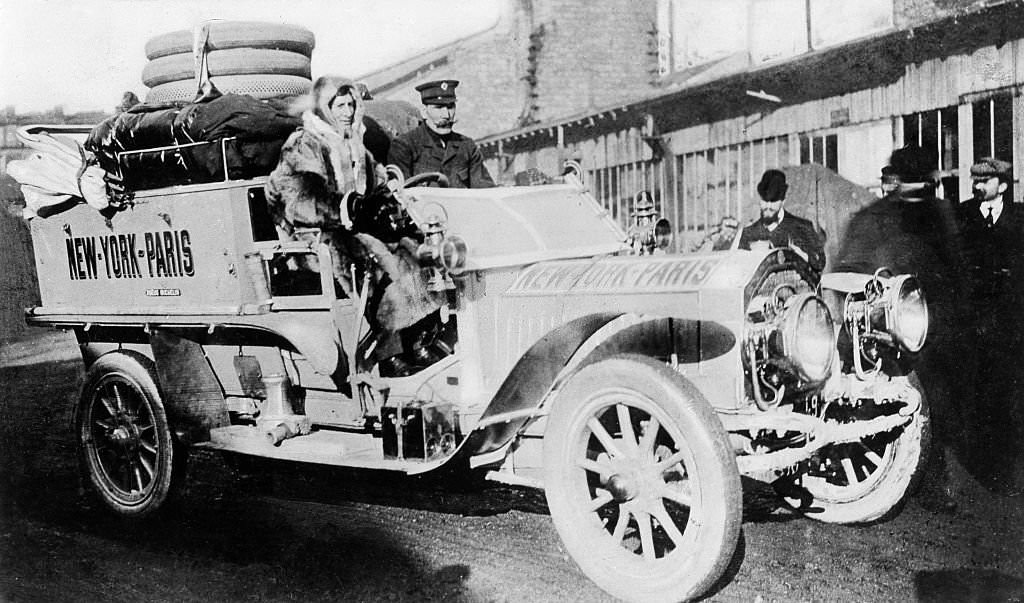
Crowds and officials cluster around a sturdy touring car marked “NEW YORK–PARIS,” its bodywork and luggage stacked high with spare tires and gear for an uncertain road ahead. The Dion-Bouton sits ready at the moment of departure, a mechanical promise of endurance with bright lamps, exposed fittings, and big spoked wheels built for rough surfaces. In the seat, Sir Chaffey—identified in the title as commissioner general of the tour organization—appears bundled against the cold, a reminder that early motoring demanded as much fortitude as it did engineering.
Along the curb, uniformed men and onlookers lean in, studying details that would have fascinated any early-20th-century audience: the strapped bundles, the heavy running boards, and the practical clutter that turned a car into a traveling workshop. The scene reads like a send-off before a marathon, where logistics and spectacle meet—exactly the mix that made the New York to Paris auto race such a sensation. Even without motion blur, the image suggests urgency, as if the last checks have been made and the city is about to fall away behind the competitors.
For readers tracing the history of the 1908 New York–Paris automobile race, this photograph captures the organizational side of the adventure as clearly as the machine itself. It’s a vivid record of early endurance racing, when international ambition rode on gasoline, grit, and careful preparation rather than streamlined modern support. As a piece of historic sports photography and early automotive history, it anchors the larger story of how motoring’s boldest journeys began—right at the edge of New York, with a packed Dion-Bouton and a crowd watching it go.