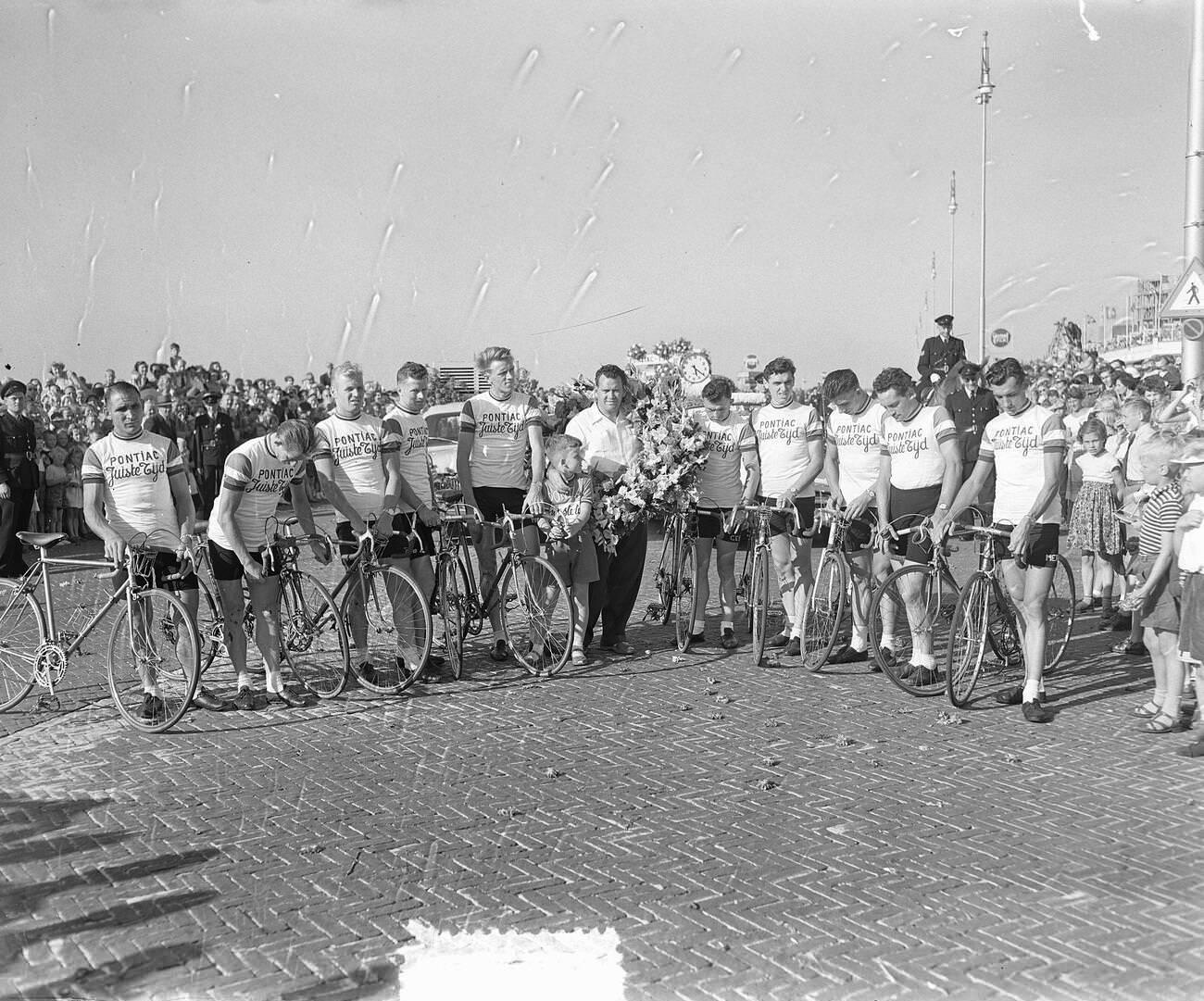
Lined up across a sunlit roadway, a Tour de France squad pauses with their racing bicycles while a crowd presses in from both sides, turning the street into an outdoor arena. Matching jerseys—clearly branded “Pontiac”—give the group a unified, professional look, and the riders’ calm, focused expressions suggest a moment between ceremony and competition. At the center, a large bouquet and officials in plain shirts hint at a presentation or pre‑stage recognition, the kind of ritual that surrounded mid‑century cycling.
Details in the machines tell their own story: slim steel frames, narrow tires, and drop handlebars built for long days in the saddle, with little visible beyond what a rider could carry and repair. The athletes stand close to their bikes as if guarding prized tools, while the simple kit and sturdy shoes evoke an era before carbon fiber, radio earpieces, and team cars loaded with spare wheels for every situation. It’s a practical, workmanlike snapshot of 1950s road racing, when endurance and tactics were matched by improvisation and grit.
Crowds like this were part of the Tour’s heartbeat, and the photograph captures that shared excitement—children at the curb, spectators leaning forward, and the team framed as local heroes for a day. For anyone searching for Tour de France history, classic cycling photography, or 1950s sports culture, the scene offers an immediate sense of scale: the riders small against the open sky, yet commanding the full attention of the street. Seen now, it reads as both a team portrait and a time capsule of European road cycling’s golden decades.